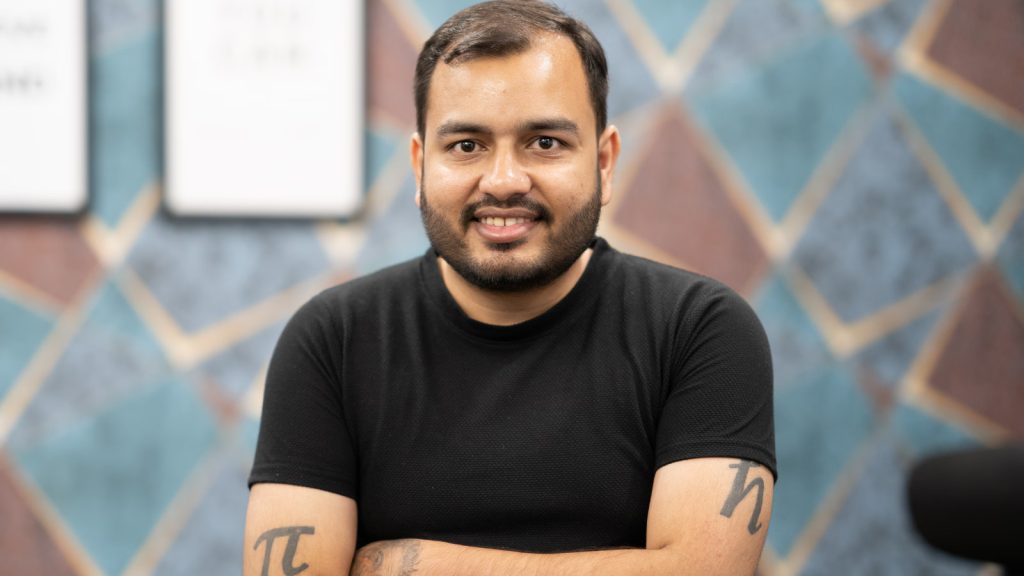

Let me tell you something about Aman Gupta that most people skip over when they’re busy talking about his net worth.
He spent years being the guy who almost got it right.
Not failing spectacularly. Not succeeding either. Just… circling. Working. Learning. And carrying this quiet, persistent feeling that the thing he was actually supposed to build hadn’t arrived yet.
That feeling followed him for a long time. And honestly, that feeling is where the real story begins.
The Comfortable Trap: From Citibank Banker to Restless Entrepreneur
Aman grew up in Delhi in a middle-class business family. His father ran a garment business, so the idea of trade wasn’t foreign to him. He knew from an early age that commerce was a living, breathing thing — not just theory in a textbook.
He studied at SRCC, one of the sharpest commerce colleges in India. Cleared his Chartered Accountancy. Joined Citibank as a banker.
On paper, the story was complete. Good family, good education, good job. Done.
But here’s the problem with a life that looks perfect on paper — you still have to live it. And Aman, sitting at his desk at Citibank, crunching numbers that weren’t his, building something that wasn’t his, kept feeling this low hum of dissatisfaction that he couldn’t turn off.
He wasn’t ungrateful. He wasn’t reckless. He was just honest enough to admit that the thing he was doing wasn’t the thing he was meant to do.
So, he quit.
He went back to help with his family’s technology business — Advanced Telemedia. He spent years there. And those years weren’t wasted — he learned how Indian retail actually works, how distributors think, how you survive when margins are razor thin and big brands have all the shelf space. He learned the unglamorous mechanics of moving physical products in a country as complicated and vast as India.
But even there, the ceiling was visible. He was helping somebody else’s dream grow, not his own.
That itch didn’t go away. So, he made a decision that many people in his position would call unnecessary, maybe even a little crazy.
He went back to school.
The Two MBAs That Changed Everything: ISB, Kellogg and a New Way of Seeing
He enrolled at ISB Hyderabad — one of Asia’s finest business schools. Then went to the United States and did his MBA from Kellogg School of Management at Northwestern.
This was not cheap. It was not easy. And it required him to put his career on pause, borrow money, and trust that whatever he was preparing for would eventually make sense.
What he got from those years was something that can’t be summarised in a degree. He got a way of seeing. He studied how brands become more than products — how a company can make a person feel something, how price and emotion and identity all tangle together in the mind of a consumer. He absorbed lessons about building at scale, about what makes people loyal to a product, about the gap between a good idea and a real business.
He came back to India with two degrees, a pile of debt, and no concrete plan. Just a direction.
He joined HARMAN International as their Sales Director for India. HARMAN owns JBL, Harman Kardon, AKG — the kings of premium audio. Every day, Aman was selling these beautiful, expensive, well-made products to a market he could see clearly through the window.
And what he saw broke something open in him.
He saw hundreds of millions of Indians who loved music, who had music on their phones, who hummed songs while they cooked and plugged themselves into the world through sound — and they were all using earphones that cost ₹150 and broke in three weeks. Not because they wanted cheap things. Because nobody had built something genuinely good at a price they could actually pay.
The companies that made great audio products — JBL, Sony, Bose — they made them for a different India. The India with the disposable income for ₹8,000 earphones. That India existed. But the other India — the bigger India, the louder India, the one that was streaming music on a ₹200 recharge — that India was completely ignored.
Aman stared at that gap every single day.
And one day, he stopped staring and started planning.
He resigned from HARMAN. Walked away from the salary, the perks, the career ladder that most people would have been perfectly happy climbing for another twenty years.
His family looked at him the way families look at someone making a decision they don’t fully understand. But he had made up his mind.
The Gap Nobody Wanted to Fix: What Aman Gupta Saw Every Day at HARMAN International
In 2016, Aman called his friend Sameer Mehta — an entrepreneur who understood manufacturing and operations — and together they founded what would eventually become boAt. They put in roughly ₹30 lakh of their own money. No venture capital, no angel investors, no safety net. Just two men in their thirties betting on themselves.
Their first product wasn’t an earphone.
It was a cable. An Apple Lightning charging cable.
iPhones were everywhere. Their original cables were notoriously fragile. People were sick of watching their ₹2,000 cable unravel at the connector after two months. Third-party options were either dangerously bad or offensively overpriced. Aman and Sameer made one that was durable, well-built, and honestly priced.
It sold. Not in a viral, overnight-sensation way. Just steadily. Reliably. The way things sell when they’re genuinely useful.
That was the proof of concept they needed. Not a billion rupees. Not a famous investor’s endorsement. Just real customers coming back because the product did what it promised.
From cables, they moved into earphones. Then wireless headphones. Then speakers. Every new product was a new education in how punishingly difficult it is to make good hardware at low prices. Every decision — which driver to use, what cable thickness to specify, what colour to launch first — was a trade-off with real money on the line.
These weren’t decisions being made in a boardroom with consultants presenting options. These were WhatsApp conversations at midnight between two sleep-deprived founders trying not to get anything catastrophically wrong.
₹30 Lakh, a Charging Cable, and Two Men Betting Everything on Themselves
Here is what the success story leaves out.
There were months — not weeks, months — when boAt was technically running out of money. Hardware is unforgiving. Every unit that comes back as a return is a direct loss. Every unsold unit sitting in a warehouse is capital bleeding slowly. Cash flow was a permanent emergency, and there were times when Aman genuinely didn’t know if the company would be alive in six months.
The manufacturing was its own special kind of nightmare. India had no consumer electronics ecosystem in 2016, so everything was sourced from factories in China. Managing quality from a different continent meant that a single miscommunication could result in an entire batch of 10,000 units arriving with something subtly wrong — and you’d only discover it after the shipment landed and customers started complaining. By then, the money was already spent.
And then there were the investors. When boAt went out to raise external capital, a lot of smart, experienced people said no. The concerns they raised weren’t unfair — consumer electronics is capital heavy, Chinese brands could undercut on price, Indian consumers weren’t known for brand loyalty in this space. But when you’re the person who has put your savings, your career, and the last several years of your life into this idea, every “no” lands like a personal verdict.
Aman has talked about this part honestly. Maintaining belief when the world keeps saying your idea probably won’t work — that’s not a business skill. It’s something deeper. It’s the ability to separate your conviction about the problem from your confidence in any given plan and keep going anyway.
The personal cost was real too. He was in his mid-thirties. He had a wife and children. His peers who had taken the safer path were visibly comfortable. There were weekends lost, family moments missed, financial pressure at home that his wife Priya absorbed with a patience he’s spoken about with genuine gratitude. Entrepreneurship costs the people around you too, and pretending otherwise is dishonest.
He paid all of it. Not because he was fearless. Because the alternative — giving up and wondering forever — felt like a worse thing to live with.
The Years Nobody Talks About: Defective Batches, Empty Accounts and Investors Who Said No
In September 2016, Mukesh Ambani launched Jio, and India was never the same.
Cheap internet arrived. Hundreds of millions of people started streaming music, watching videos, living their digital lives on phones they already had in their pockets. Overnight, the demand for affordable earphones didn’t just grow — it exploded.
At the same time, Amazon and Flipkart made it possible for a startup with no physical retail presence to reach a customer anywhere in the country. You no longer needed to fight for shelf space in a store in Connaught Place to sell to someone in Lucknow.
But Aman didn’t win just because he was in the right place at the right time. A lot of companies were in the right place. Most of them disappeared anyway.
What made boAt different was how it spoke to people.
Every other earphone brand in India was marketing on specifications — bass response, driver size, impedance numbers that most customers didn’t understand and didn’t care about. Aman, who had studied brand psychology at Kellogg and watched JBL operate up close, understood something fundamental. People don’t buy products. They buy versions of themselves.
So, boAt never marketed itself as the most technical earphone. It marketed itself as the earphone for people who are bold, who move, who don’t settle. The ambassadors they chose — Hardik Pandya, KL Rahul, Diljit Dosanjh — weren’t safe corporate picks. They were cultural figures who represented a new India that was confident, loud, and unapologetic about enjoying life.
Their social media felt like a friend’s feed. Their colours were vivid. Their campaigns were meme-friendly and warm. And young India — the India that was streaming Spotify on Jio data from a hostel room — felt seen by this brand in a way that Sony and JBL, for all their quality, never managed.
They weren’t selling earphones. They were selling a tribe to belong to.
Shark Tank India and the Night “Boht Hard Hai” Became Part of Indian Pop Culture
In 2021, Shark Tank India launched and Aman sat on the panel as one of the investors.
Millions of Indians tuned in expecting the usual TV dynamic — nervous entrepreneurs, intimidating investors, dramatic rejections. What they got was something different.
Aman was funny. He was warm. When a young founder sat across from him with shaking hands and a half-baked pitch, he didn’t perform superiority. He leaned in with real curiosity and asked the questions a mentor asks — not to expose, but to understand. And when he talked about his own journey, about being rejected by investors, about the nights he wasn’t sure boAt would survive, it didn’t sound like a prepared speech. It sounded like a man telling the truth about something painful.
His phrase — “Boht hard hai” — became one of the most-quoted lines in Indian pop culture that year. Not because it was clever. Because it was honest. And when a man who built a ₹3,000 crore company from nothing still says “it’s very hard” with a straight face and genuine humility, everyone watching who is struggling with something feels a little less alone.
Shark Tank made boAt famous to people who had never seen a boAt advertisement. Mothers bought it because they trusted the man who made it. Students bought it because they respected his story. That kind of loyalty cannot be purchased with a marketing budget. It has to be earned over years of actually being the person you appear to be.
Where He Stands Today
boAt is now the number one audio wearables brand in India. It outsells Sony. It outsells JBL. It ships over a crore units a year, covers everything from ₹399 earphones to smartwatches, and generates over ₹3,000 crore in annual revenue. An IPO is in the works. The company that started with ₹30 lakh is now worth hundreds of millions of dollars.
Those are the numbers. But they’re not really the point.
The point is everything that came before. The restless CA at Citibank. The years in the family business learning things no classroom teaches. The two MBAs that were really just two acts of refusing to stop growing. The observation from inside HARMAN that millions of people were being ignored by the industry. The launch with a cable. The factories in China. The investors who said no. The months with no money in the bank. The personal sacrifices that don’t show up in any article about his success.
The point is that nothing about this story was inevitable. There were a hundred moments where a reasonable person would have stopped. Where the math didn’t add up, where the world was saying quit, where comfort was available and the harder path was not guaranteed to lead anywhere.
He stayed anyway.
From ₹30 Lakh to ₹3,000 Crore: What the Real Lesson of boAt Actually Is
Aman Gupta didn’t invent anything. He didn’t discover a new technology or patent a revolutionary product. He looked at an ordinary thing — earphones — and asked why ordinary people couldn’t afford a decent one. Then he spent years, through every kind of difficulty, building the answer.
The lesson isn’t about being extraordinary. It’s about being honest enough to see a real problem, stubborn enough to keep working when nothing is going well, and human enough to admit that the fear never fully goes away — you just get better at moving through it.
The courage wasn’t in starting boAt. Plenty of people start things.
The courage was in the Tuesday mornings, three years in, when the money was thin and the investors had said no and the product had a defect and the team was exhausted — and he came in anyway, sat down, and kept building.
That’s the real story.
And honestly? It sounds a lot more like your life and mine than the highlight reel ever will.
“I failed multiple times. But I never stopped trying. That’s the only difference between me and someone who didn’t make it.” — Aman Gupta, Founder, boAt