The Wall Every Founder Hits
Picture this.
You’ve spent two years building your startup from scratch. You have a product people actually want. You have early customers paying you money. You have a team that believes in what you’re doing. And now you need capital — not a fortune, just enough to hire three more engineers, expand to a new city, or ramp up production.
So, you walk into a bank.
And they ask you one question that stops everything: “What collateral do you have?”
No property. No fixed assets. No gold. Just your idea, your team, and your traction.
The bank shakes its head. You walk out empty-handed.
This story plays out thousands of times every year across India. And it’s not because banks are evil or founders are incompetent. It’s a structural problem — banks need security, and startups, by nature, don’t have traditional assets to offer. They’re asset-light, idea-heavy businesses running on potential. And potential doesn’t fit neatly into a bank’s loan approval checklist.
That’s the problem the Credit Guarantee Scheme for Startups (CGSS) was born to solve. And from where things stand today, it’s doing exactly that — quietly, systematically, and at scale.
What Is CGSS, Really?
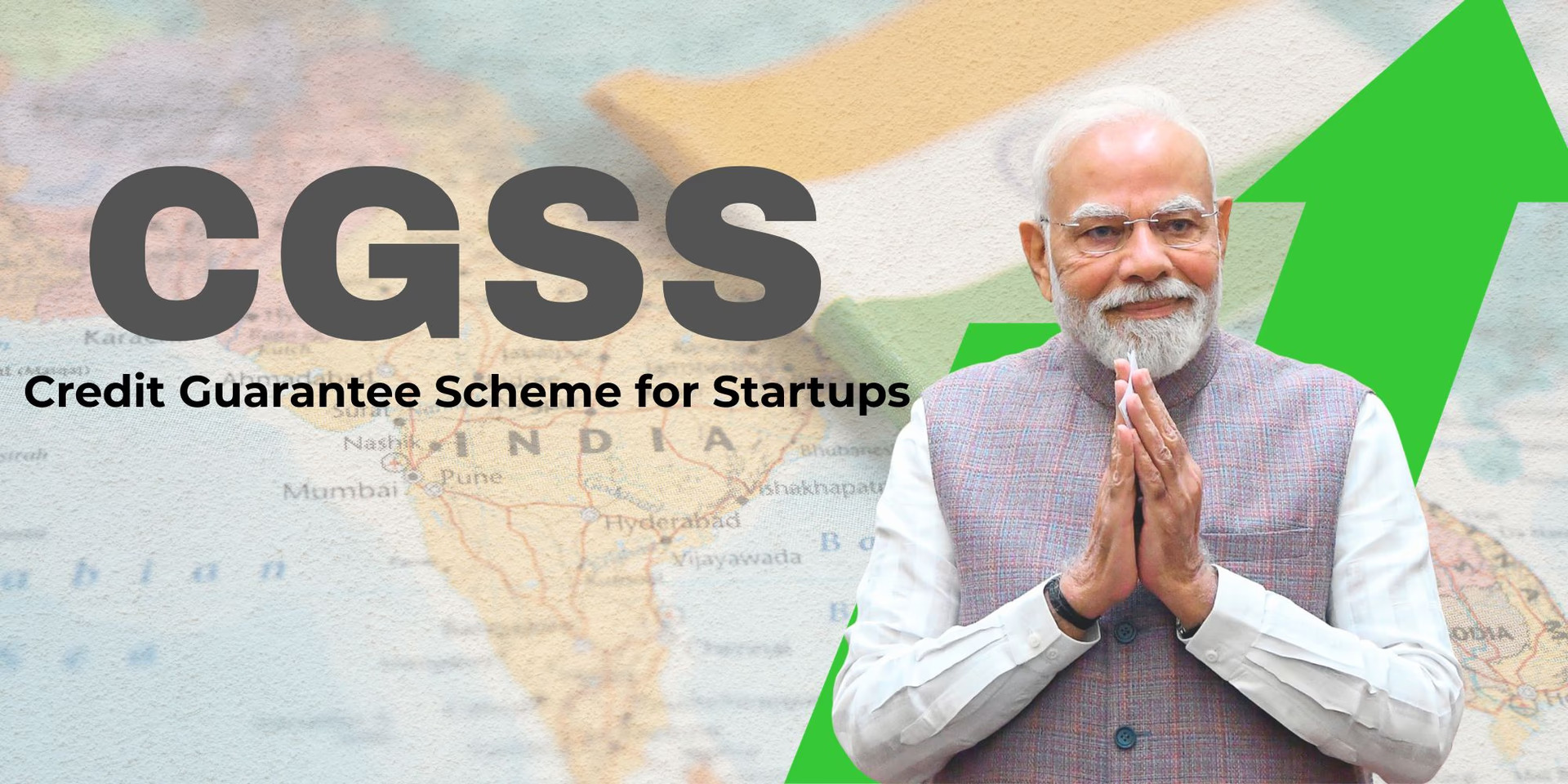
At its core, CGSS is a government-backed guarantee scheme launched by the Department for Promotion of Industry and Internal Trade (DPIIT). In plain English, the government steps in and tells banks: “Lend to this startup. If they default, we’ll cover a major chunk of your loss.”
That one promise changes everything.
Suddenly, the bank’s hesitation melts away. The startup doesn’t need to pledge its founder’s house or parents’ savings. The loan flows. The startup grows. The economy benefits.
It covers term loans, working capital, and even venture debt — giving startups flexibility in what they borrow and how they use it. The scheme is available to all DPIIT-registered startups, meaning if you’re officially recognised as a startup by the government, this door is open for you.
The Collateral Wall — Officially Demolished
For decades, the Indian credit system has been built around one concept: security. Banks lend against something tangible — a house, land, machinery, gold. If the borrower vanishes, the bank recovers its money by selling the asset.
But what happens when the borrower’s greatest asset is a great idea?
You can’t foreclose on intellectual property. You can’t auction off a software platform. You can’t sell a startup’s customer goodwill in a court-mandated sale.
This is why startups have historically been shut out of formal lending. Not because they’re bad businesses — but because their value exists in forms the traditional banking system wasn’t designed to recognise.
CGSS bridges this gap with a beautifully simple mechanism:
- The government guarantee fund absorbs the lender’s risk
- Banks no longer need collateral because the guarantee itself is the security
- Startups can access real institutional credit based on their business potential, not their physical assets
This is more than a financial instrument. It’s a philosophical shift in how India extends credit — from “what do you own?” to “what are you building?”
Lower Fees for Those Who Need It Most
One of the most human aspects of CGSS is its fee structure. It doesn’t treat every startup the same, because not every founder starts from the same place.
The annual guarantee fee — what startups pay to access the scheme — is structured as follows:
| Category | Annual Fee |
| Standard Startups | 2% per annum |
| Women Entrepreneurs & Northeast India | 1.5% per annum |
| Manufacturing & Champion Sectors | 1% per annum |
Think about who benefits from those lower rates.
Women entrepreneurs have historically faced a double disadvantage — limited access to family wealth (because property inheritance often skips daughters) and unconscious bias from lenders who underestimate their creditworthiness. A lower fee is a small but meaningful acknowledgment of that systemic inequality.
Startups from Northeast India operate in a region that has long been economically and infrastructurally behind the rest of the country. Cheaper access to credit is one way to level that playing field without loud fanfare.
Manufacturing startups are the engine of job creation and supply chain development. Encouraging them with lower costs aligns perfectly with India’s “Make in India” ambitions — making it economically rational to build physical things in this country rather than import them.
This isn’t charity. It’s smart policy design.
2025: The Year CGSS Got Serious About Scale
If there was any doubt about whether CGSS was just a pilot scheme or a long-term commitment, the 2025 upgrade settled it.
The government doubled the credit ceiling — from ₹10 crore to ₹20 crore.
And with it came a restructured coverage framework:
- 85% coverage for loans up to ₹10 crore
- 75% coverage for loans between ₹10 crore and ₹20 crore
Let’s put ₹20 crore in context for a moment.
That’s enough to build a full product engineering team. Enough to launch a national sales operation. Enough to set up a manufacturing facility. Enough to run a year-long marketing campaign and build genuine brand equity.
Previously, a startup needing that kind of capital had two realistic options: find a venture capital investor (and dilute significant ownership) or stay small. CGSS has now added a third option — take debt, stay in control, and scale on your own terms.
For founders who’ve spent years building something valuable and don’t want to give half of it away to a fund manager, this is nothing short of a lifeline.
A Lending Network That Actually Reaches You
CGSS would be useless if it only worked through one government window in Delhi. Thankfully, it doesn’t.
The scheme works through an impressively wide network of lenders:
Public Sector Banks — SBI, PNB, Bank of Baroda, and others. These are the banks with branches in every city, town, and district. For a founder in Jaipur, Indore, or Coimbatore, this means CGSS isn’t some distant central government scheme — it’s accessible at a familiar bank branch down the road.
Private Sector Banks — HDFC Bank, IDFC First, Yes Bank. These institutions are known for faster processing, better digital interfaces, and relationship managers who actually understand startups. For founders in metro cities or those comfortable with tech-first banking, this opens a smoother lane.
NBFCs (Non-Banking Financial Companies) — Often more flexible in underwriting than traditional banks, NBFCs serve the founders who don’t fit the standard banking checklist. They look at cash flows, business models, and future potential rather than purely historical financials.
AIFs and AIFIs — SEBI-registered Alternative Investment Funds and All-India Financial Institutions bring institutional sophistication to the mix, especially useful for startups at slightly later stages needing larger ticket sizes.
The diversity of this network isn’t accidental. It ensures that CGSS doesn’t just serve the well-connected founders in Bengaluru and Mumbai — it reaches the determined entrepreneur in Nagpur, Guwahati, and Kochi too.
The Jan Samarth Portal: Transparency as a Feature
Here’s something that rarely gets mentioned but genuinely matters: CGSS is entirely accessible through the Jan Samarth Portal — a single digital platform where founders can discover, apply for, and track their loan applications.
Why does this matter so much?
Because traditionally, navigating government credit schemes required knowing the right people. It meant visiting multiple offices, talking to consultants who charged for information that should be freely available, and operating in a fog of uncertainty about where your application stood.
Jan Samarth changes that dynamic:
- Discover your eligibility before ever speaking to a bank
- Apply digitally without needing to physically visit multiple branches
- Track your application status in real time
This transparency isn’t just convenient — it’s democratising. A first-generation entrepreneur in a small town now has access to the same information and application process as a well-networked founder in a startup hub. The portal removes geography, connections, and insider knowledge as prerequisites for accessing government support.
The Bigger Picture: Why This Actually Matters
Step back from the percentages and rupee figures for a moment, and ask a bigger question: Why does this approach matter more than just handing out grants?
The answer is about what kind of businesses we want to build in India.
Grants and subsidies have their place. But a startup that survives primarily on government handouts hasn’t really proven itself. It hasn’t demonstrated that its product generates enough value for customers to pay for it, that its operations are efficient enough to service debt, or that its business model is sustainable without external support.
CGSS builds a different kind of muscle.
When a startup takes a ₹5 crore loan and repays it successfully, something important happens. The startup builds a credit history. It demonstrates financial discipline. It earns trust with lenders that unlocks future, larger, and eventually non-guaranteed financing. It grows up, financially speaking.
This shift — from subsidy dependency to credit-linked empowerment — is what makes CGSS philosophically important, not just financially useful.
India’s startup ecosystem has produced dozens of unicorns and hundreds of successful exits. But those success stories represent a tiny fraction of the founders who tried. The ones who failed often weren’t short on ideas — they were short on capital at a critical moment. CGSS is the mechanism that ensures more of those critical moments don’t end in an unnecessary shutdown.
What This Means If You’re a Founder
If you’re running a DPIIT-registered startup, here’s the practical takeaway:
Before you give away equity to an investor at terms that don’t favour you, before you approach a moneylender, before you take a personal loan and put your family finances at risk — explore CGSS.
Log onto the Jan Samarth Portal. Check your eligibility. Understand what coverage applies to your sector. Approach a participating lender with the knowledge that the government is standing behind your loan application.
You might be surprised by how much has changed.
Closing Thought
The best startup ecosystems in the world aren’t just celebrated for the companies they produce. They’re celebrated for how they treat the founders who tried and didn’t make it — for the systems they build that reduce the cost of entrepreneurship for everyone.
CGSS is India’s serious attempt at building that kind of ecosystem.
It won’t make headlines the way a $100 million funding round does. It won’t trend on Twitter. But somewhere in India right now, a founder is walking into a bank with no collateral and walking out with a loan — because the government quietly guaranteed it.
That’s not a small thing.
That’s a game changer.