Think about the last time you had to toggle between six different tools to get one piece of work done. You pulled data from Salesforce, cross-referenced it in Snowflake, built a chart in Tableau, filed a ticket in Jira, chased an approval over email, and by the time you had your answer, half the morning was gone. Nobody signed up for that when they joined a company. But somehow, that became what modern enterprise work looks like.
Josh Sirota watched this happen from the inside for years — first at Oracle, then at Salesforce, where he helped scale a business unit from zero to $200 million in annual recurring revenue. And when he finally decided he’d had enough of watching smart people waste hours navigating software that was supposed to make their lives easier, he quit, moved to a live-work loft in San Francisco across the street from the Giants’ baseball stadium, gathered a small team, and set out to build something different.
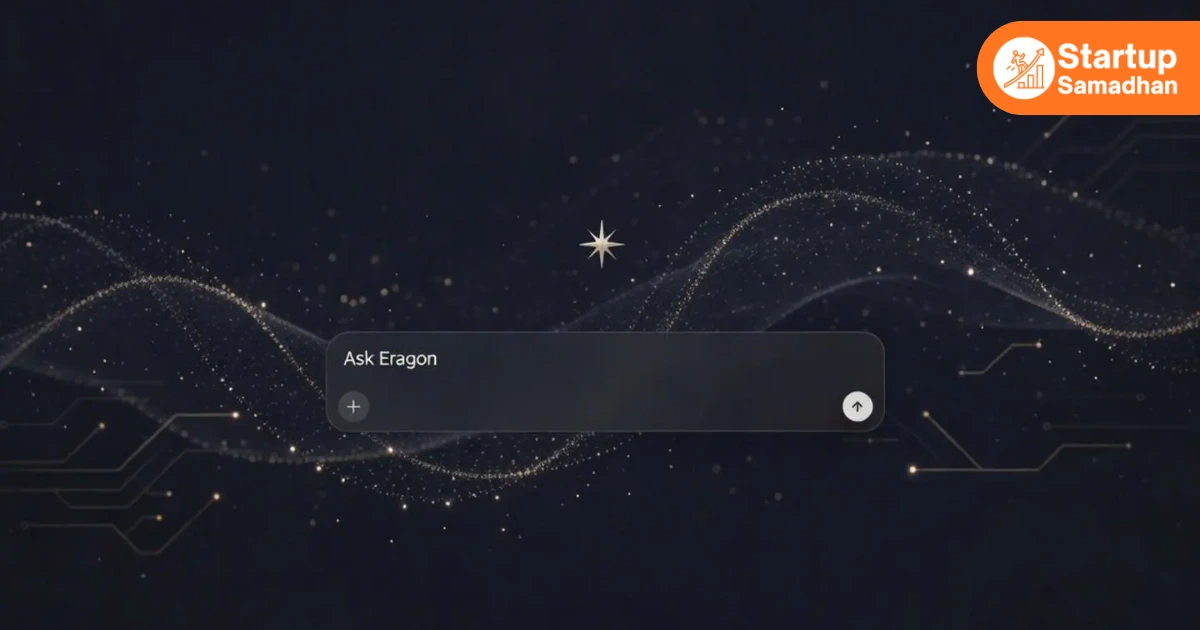
That something is Eragon — a San Francisco-based AI startup that raised $12 million at a $100 million post-money valuation on March 18, 2026, to build what it calls an agentic AI operating system for enterprise. One platform. One interface. And instead of buttons and menus — just a prompt.
The Round — Who Believed in This Before the World Did
Sirota’s experience implementing the world’s premier corporate software convinced investors of his “founder-market fit.” The funding round came together with a sharp mix of institutional conviction and strategic angels who understand the enterprise world from the inside:
- Lead investor: Arielle Zuckerberg at Long Journey Ventures
- Co-investors: Soma Capital and Axiom Partners
- Strategic angels: Mike Knoop (co-founder of n8n, one of the most widely used workflow automation platforms) and Elias Torres (co-founder of Drift, the pioneer of conversational marketing)
- Round type: Seed funding
- Valuation: $100 million post-money
- Date: March 18, 2026
Sandhya Venkatachalam of Axiom Partners summed up the investment thesis clearly: Eragon has the potential to become the connective tissue for how modern teams operate and make decisions. That’s not typical investor boilerplate — that’s an acknowledgment that the problem Eragon is solving sits at the centre of how every knowledge-work organisation functions.
The Founder — A Quarter-Life Crisis That Became a $100 Million Idea
Josh Sirota didn’t start Eragon from a research lab or a university dorm. He started it from a place of genuine professional frustration — the kind that only builds up after years of watching the same problem repeat itself inside the world’s largest software companies.
At Oracle, he learned how enterprise software gets sold and implemented. At Salesforce, he scaled an operating unit from inception to $200 million ARR, which gave him an unusually clear view of where the real friction lived — not in the product demos, but in day-to-day usage by actual employees.
He admits to suffering a bit of a quarter-life crisis in the lead-up to moving to San Francisco and launching Eragon with a small team from a live-work loft across the street from the Giants’ baseball park. The name itself came from the Christopher Paolini fantasy novel sitting on his dining table — a nod to a tradition of great tech companies borrowing from fictional universes, much like Palantir and Anduril did before Eragon.
The core thesis he arrived at is bold to the point of being provocative: “Software is dead.”
Not the companies. Not the data. Not the workflows. But the interface — the buttons, the dropdown menus, the dialog boxes, the tabs — all of it is in the process of becoming obsolete. The future of enterprise software isn’t another dashboard. It’s a prompt.
What Eragon Actually Does — The Product Explained Simply
Eragon is building what it calls an Agentic AI Operating System for businesses. That term sounds abstract until you see it in practice, so here’s what it actually means:
Instead of opening five different tools to answer a business question or complete a task, you open Eragon and describe what you want in plain language. The platform takes that request, connects to all your enterprise systems — your CRM, your data warehouse, your email, your ticketing tools, your identity management — and handles the rest autonomously.
Here’s how the core architecture works:
- Custom model training: Eragon takes open-source large language models like Qwen and Kimi and post-trains them on each client’s proprietary data — inside the client’s own secure environment, never on external servers
- Enterprise system integration: The platform connects to Salesforce, Snowflake, Tableau, Jira, email accounts, ERP systems, and other core enterprise tools through a unified interface
- Agentic execution: It doesn’t just answer questions — it takes action. Ask Eragon to onboard a new client and it automatically provisions credentials, spins up cloud instances, syncs data sources, and initiates workflows — all from a single natural language command
- Dashboard generation on demand: Need a board-ready revenue dashboard? You ask for it in plain language and it’s created, with the underlying data pulled automatically from connected systems
- Autonomous workflow automation: Invoice approvals, deal risk analysis, supply chain optimisation recommendations — Eragon handles these by chaining together retrieval, analysis, and task execution without requiring a human to navigate between tools
- Privacy-first model ownership: Unlike API-based AI tools where your data touches an external server, Eragon runs entirely within a company’s own cloud perimeter. The company owns its model weights — the underlying trained parameters — which Sirota believes will become enormously valuable assets as they accumulate years of proprietary business data
The Technical Team Behind It
A bold vision only becomes a real product when you have the engineering talent to back it. Eragon’s technical team is built around two researchers who come from the sharpest academic institutions in the world:
- Rishabh Tiwari — A Computer Science PhD student at UC Berkeley, leading the platform’s reasoning and orchestration architecture
- Vin Agarwal (Vinayak Agarwal) — An MIT PhD who co-founded K-Dense, an AI agent for scientific research that was validated in partnership with Harvard Medical School. He brings deep expertise in applied AI systems and research-grade model development
Their blend of GTM expertise and agentic AI research positions Eragon to run companies from idea to IPO — an ambitious statement, but one that the team’s credentials at least make worth taking seriously.
The Clients Already Using It — And What They’re Saying
Eragon is already deployed across several large enterprises and dozens of startups. One of its most telling early adopters is Corgi — an insurance startup that raised $180 million after emerging from Y Combinator. Corgi’s CEO Nico Laqua called Eragon the best applied AI for enterprise in the market today.
The reason Corgi chose Eragon is instructive: “Most of the data we have needs to remain secure and behind our own cloud. Eragon trains state-of-the-art models for us on our data and deploys it in our own environment.” For a regulated industry like insurance — where data governance, compliance, and privacy are non-negotiable — that kind of architecture isn’t a nice-to-have. It’s the entire reason to choose Eragon over a generic API-based copilot.
Other early clients include Dedalus Labs, which was onboarded live during a product demonstration — the entire process triggered by a single natural language command.
The Market Eragon Is Entering — And Why the Timing Is Right
The enterprise AI market isn’t just growing — it’s compounding. The enterprise AI market stands at $28.38 billion in 2025, projected to reach $40.45 billion by 2026 at a 42.5% CAGR. But beyond the headline numbers, the structural problem Eragon is solving is even more widely documented:
- Large companies now deploy well over 200 apps on average, fragmenting data and workflows
- Workers spend roughly 20% of their time searching for information scattered across those tools — not doing actual work, just navigating the maze of software they’re supposed to work in
- Companies are increasingly seeking ways to leverage AI for enhanced efficiency and strategic insights, but the fragmented, multi-tool environment makes consistent AI adoption genuinely hard
Eragon’s pitch is that a natural language operating system that unifies all enterprise data, tools, and workflows into a single prompt-driven interface is the only way to break this logjam. And Nvidia CEO Jensen Huang validated a remarkably similar thesis just days after Eragon’s funding announcement at Nvidia’s GTC developer conference — arguing that every SaaS company will eventually evolve into an agentic-as-a-service provider.
The Real Challenge Ahead — Eyes Open on the Risks
Eragon is a genuinely compelling idea. But the history of enterprise AI is littered with compelling ideas that stalled at the pilot stage. MIT Sloan Management Review has reported that a large majority of AI pilots stall before scale, often due to data quality issues, missing governance, and unclear ROI.
In agentic systems specifically, the failure modes are more serious than in passive AI tools. When an AI agent doesn’t just answer a question but takes action — approving invoices, provisioning users, modifying workflows — a misinterpretation or incorrect retrieval doesn’t just give you a wrong answer. It can cascade into real business consequences before a human even notices.
Sirota is aware of this. The platform includes simulation capabilities for testing before deployment, human approval loops for sensitive actions, and the privacy-first architecture that keeps model training inside the client’s own environment. But the real test will come as Eragon moves from dozens of startups to hundreds of large enterprises with complex, legacy data environments and genuine regulatory exposure.
The Ambition Is Not Subtle
Sirota has said he expects Eragon to be a billion-dollar company by the end of 2026. At a current valuation of $100 million, that would require a 10x step-up in under twelve months. It’s an audacious target — the kind that either marks a founder who has lost perspective, or one who genuinely sees something that the rest of the market hasn’t priced in yet.
The comparison Sirota himself reaches for is the transition from centralised mainframes to personal computers. Frontier AI labs offer powerful, centralised models accessible via API. But just as mass PC adoption required local, bespoke tools tailored to specific needs, mass enterprise AI adoption will require agents and models built on proprietary data, owned and controlled by the companies that generated that data. That’s Eragon’s lane — and if the analogy holds, it’s a very large lane indeed.
Quick Facts at a Glance
- Startup: Eragon
- Founded: August 2025
- Headquarters: San Francisco, USA
- Founder: Josh Sirota (CEO) — ex-Oracle, ex-Salesforce (scaled unit to $200M ARR)
- Technical co-founders: Rishabh Tiwari (Berkeley CS PhD), Vin Agarwal/Vinayak Agarwal (MIT PhD, co-founder K-Dense)
- Funding raised: $12 million
- Valuation: $100 million post-money
- Announcement date: March 18, 2026
- Lead investor: Arielle Zuckerberg, Long Journey Ventures
- Co-investors: Soma Capital, Axiom Partners
- Strategic angels: Mike Knoop, Elias Torres
- What it builds: Agentic AI Operating System for enterprise — prompt-driven interface replacing traditional software UIs
- Key integrations: Salesforce, Snowflake, Tableau, Jira, email, ERP systems, identity providers
- AI models used: Open-source models (Qwen, Kimi), post-trained on client’s proprietary data
- Security model: Fully within client’s own cloud perimeter — company owns model weights
- Early clients: Corgi (YC-backed, $180M raised), Dedalus Labs, several Fortune-class enterprises
- Founder’s target: Billion-dollar company by end of 2026