Setting up an office in India has always been a nightmare. This Gurugram startup is done pretending that’s okay.
Ask any founder who has set up an office in India and watch their face change. There’s a specific kind of exhaustion that comes with it — the contractor who goes silent for two weeks, the furniture vendor who quotes one price and delivers another, the designer who produces a gorgeous presentation and then vanishes into thin air. By the time the office is actually ready, you’ve spent more than you planned, waited longer than you should have, and aged a little in the process.
Tushar Mittal didn’t just experience that chaos. He decided to dismantle it.
His company, OfficeBanao, has just closed a pre-Series A2 funding round worth approximately ₹34.8 crore — close to $3.76 million — with lead investor Lightspeed doubling down on its earlier bet, and two new names, Mangum II and Medra Family, joining the cap table. It’s a confident round. And if you pay attention to what OfficeBanao has been quietly building over the last three years, it starts to make a lot of sense.
Why This Round Actually Matters
Lightspeed led OfficeBanao’s seed round back in 2023 as well — a $6 million raise that gave the startup its early runway. The fact that the same fund has come back for the next round is one of those understated signals that the startup world tends to overlook. Investors who live inside a company’s numbers, watch its team make decisions under pressure, and see how it handles the messy middle of growth — when they write another cheque, it means something real.
The round was structured in two tranches, with shares allotted in late December 2025 and then again in January 2026. The pre-money valuation at which this capital came in sits at roughly ₹522 crore — about $56.5 million. For a company still at the pre-Series A stage, that’s not a modest number. It reflects a market that is starting to wake up to the scale of opportunity sitting inside India’s deeply disorganised interior design and workspace sector.
The Problem Is Bigger Than It Looks
Here’s something that doesn’t get talked about enough: the office interiors market in India is enormous, and almost entirely unorganised. There is no standard pricing, no single point of accountability, no transparent process. You hire one contractor, who outsources to another, who sources materials from a third party you’ve never met — and the moment something goes wrong, everyone points at someone else.
This isn’t just inconvenient for startups trying to fit out a 2,000 sq ft space. It’s a structural failure that affects businesses of every size, from a bootstrapped team renting their first real office to a mid-sized enterprise trying to expand across five cities simultaneously. The pain is universal. The solution, until recently, simply didn’t exist.
OfficeBanao’s answer is to bring the entire thing under one roof — and to use technology to do the heavy lifting. The platform connects clients with designers, architects, contractors, furniture vendors, and material suppliers, but crucially, it doesn’t just make introductions and step aside. It holds the whole process together with AI-powered space planning tools, 3D walkthroughs that let you actually see your office before a single wall is touched, real-time collaboration features, and transparent pricing that takes the guesswork — and the guessing games — out of the equation entirely.
The project range is also worth noting. OfficeBanao handles everything from relatively small fitouts starting at around ₹10 lakh all the way up to large enterprise projects crossing ₹5 crore. That kind of range means the platform is genuinely built for India’s real business landscape — not just the unicorn-adjacent startups in Bengaluru, but the thousands of growing SMEs in Jaipur, Lucknow, Pune, and everywhere in between.
The People Running It
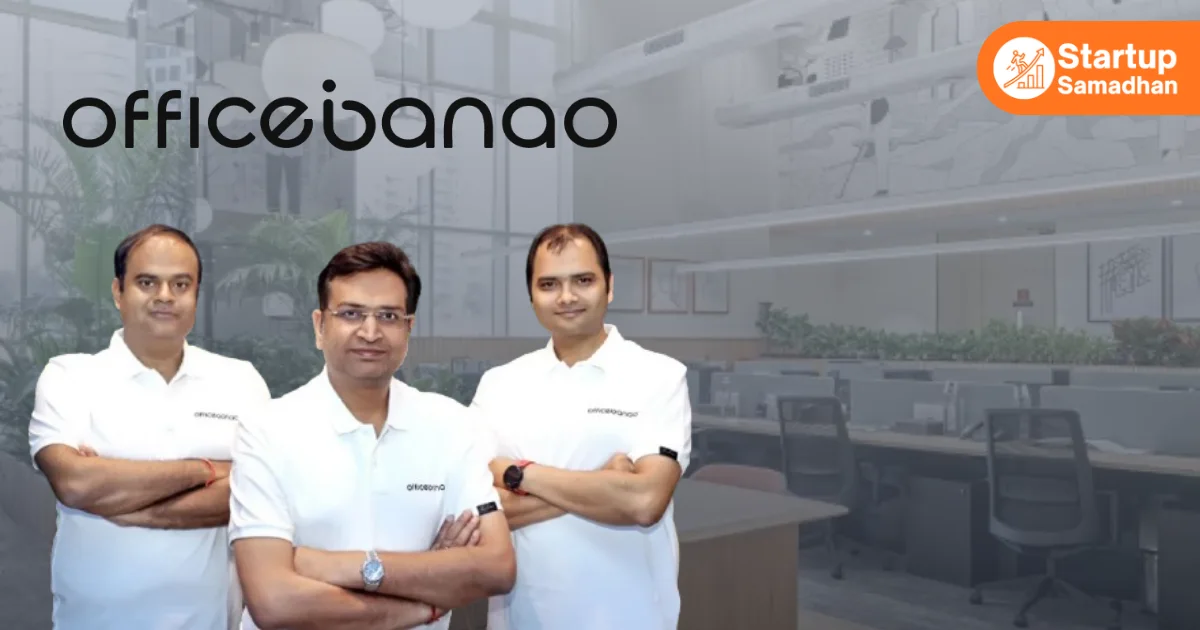
Tushar Mittal founded OfficeBanao in early 2022, alongside co-founders Akshya Kumar and Divyanshu Sharma. Mittal leads as CEO, Kumar drives technology as CTO, and Sharma owns business and product as Chief Business and Product Officer. Between them, they bring a firsthand understanding of why the interiors industry works the way it does — and an impatience with the idea that it always has to.
Mittal’s founding thesis is straightforward and hard to argue with: the office design and development experience for small and mid-sized businesses in India is fundamentally broken, and only a technology-first approach can fix it properly. Not partially fix it. Not make it slightly more bearable. Actually fix it — so that a business owner can go from brief to move-in without losing sleep.
That conviction has clearly resonated with the people writing the cheques.
The Market Timing Is Right
The interior design market in India is not a niche play. Industry projections put it on a trajectory toward $74 billion-plus by the mid-2030s, growing at a steady clip year after year. That growth is being driven by a combination of rapid urbanisation, a booming startup ecosystem that constantly needs new workspaces, and a wider cultural shift in how Indian businesses think about their physical environment. The office is no longer just a place to work — it’s a statement about who you are as a company, how you treat your team, and what you’re building.
OfficeBanao isn’t alone in noticing this. Flipspaces pulled in around $50 million across multiple tranches last year. The co-founders behind PharmEasy launched a new architectural and interiors venture called All Home in 2025 and reportedly raised at a $120 million valuation right out of the gate. The segment is gathering serious momentum, and the investors who’ve been watching from the sidelines are now actively moving in.
The difference, of course, is execution. And that’s where OfficeBanao’s three years of building — getting the technology right, assembling the supplier ecosystem, figuring out which cities to prioritise and why — starts to feel like a real advantage.
What the Fresh Capital Unlocks
OfficeBanao is currently live in more than 15 cities across India. The next phase is about going deeper, not just wider. The plan is to establish a meaningful ground presence across the top 25 markets, which means investing in local customer success teams, building out the network of execution partners — the contractors and suppliers who actually deliver the finished product — and giving those partners better tools, better procurement access, and better processes so that quality stays consistent as the company scales.
That last point is quietly one of the most important things the startup is doing. Most platforms at this stage focus almost entirely on the demand side — get more clients, close more projects. OfficeBanao is equally invested in the supply side, because they understand something that companies in this space often learn the hard way: a platform is only as good as the partners executing under its brand name. If a contractor cuts corners on a project that came through OfficeBanao, it’s OfficeBanao’s reputation that takes the hit.
Organising and empowering the supply chain is therefore not just an operational decision. It’s a product decision. And it’s the kind of thinking that separates companies building real businesses from those building clever-sounding presentations.
The Bottom Line
India’s office interiors market has been a mess for a long time — and for a long time, that mess was just accepted as the cost of doing business. OfficeBanao is arguing, with growing evidence on its side, that it doesn’t have to be.
With ₹34.8 crore in fresh capital, a returning lead investor who knows exactly what they’re backing, a valuation that puts the company firmly on the venture-scale map, and a market that is only going to get bigger as India’s economy grows — the pieces are in place for something meaningful.
The office of the future is going to be built with technology at its foundation, with transparency baked in from day one, and with someone accountable at every step of the process. OfficeBanao is making its case to be that someone.
And going by the capital flowing its way, the market seems inclined to agree.