The Startup That Chose the Hard Problem
Walk into Newtrace’s facility in Bengaluru and you’ll find something that looks less like a typical Indian startup and more like a research laboratory that decided, somewhere along the way, that it also wanted to change the world. Over 45 engineers and scientists show up here every day to work on a problem that has stumped energy companies, governments, and climate scientists for decades — how do you make green hydrogen cheap enough to actually matter?
It’s a question with enormous stakes. Green hydrogen — produced by splitting water using renewable electricity rather than fossil fuels — is considered one of the most promising pathways to decarbonising hard-to-electrify sectors. The science has always been sound. The economics, unfortunately, have not. Production costs have historically been too high, and the infrastructure to support large-scale use barely exists. But that’s exactly the gap Newtrace was built to close.
Key sectors green hydrogen can decarbonise:
- Steel manufacturing
- Fertiliser production
- Shipping and heavy transport
- Oil refining
- Heavy industry and chemicals
This week, the Bengaluru-based cleantech startup announced it has raised $6.3 Mn — approximately ₹56.93 Cr — in a Pre-Series A funding round. The round was led by HDFC Bank Limited and Mitsui Sumitomo Insurance Venture Capital, and it marks a pivotal moment in Newtrace’s journey from being a deep-tech research venture to becoming a commercially viable business with a real product to sell.
Funding Round — The Numbers and the Names
Round Details at a Glance:
- Round Type: Pre-Series A
- Amount Raised: $6.3 Mn (approximately ₹56.93 Cr)
- Lead Investors: HDFC Bank Limited, Mitsui Sumitomo Insurance Venture Capital
- Existing Investors (Follow-on): Aavishkaar Capital, Speciale Invest, Micelio Technology Fund, Peak XV’s Surge
- Angel Investors: Manish Prataprai Gandhi, Renu Manish Gandhi
- Previous Round: $5.7 Mn Seed Round (2023)
- Total Funding to Date: Approximately $12 Mn
What makes this funding round interesting is not just who led it, but who stuck around for it. Every major existing backer came back to the table — a quiet but powerful signal of continued confidence. Repeat investment from early-stage backers is rarely accidental. It tells you something meaningful about what these investors have seen from the team in the two years since the seed round.
Joining them in this round are HDFC Bank, one of India’s most trusted and conservative financial institutions, and Mitsui Sumitomo Insurance Venture Capital, a Japanese investor with deep roots in industrial and infrastructure sectors. The fact that both chose to lead a Pre-Series A in a green hydrogen startup signals that the institutional conversation around clean energy in India is genuinely maturing. These aren’t speculative bets from venture funds chasing themes. These are deliberate, strategic investments from organisations with long investment horizons and significant due diligence standards.
The Founders — Two People Who Chose the Hard Road
Founder Profiles:
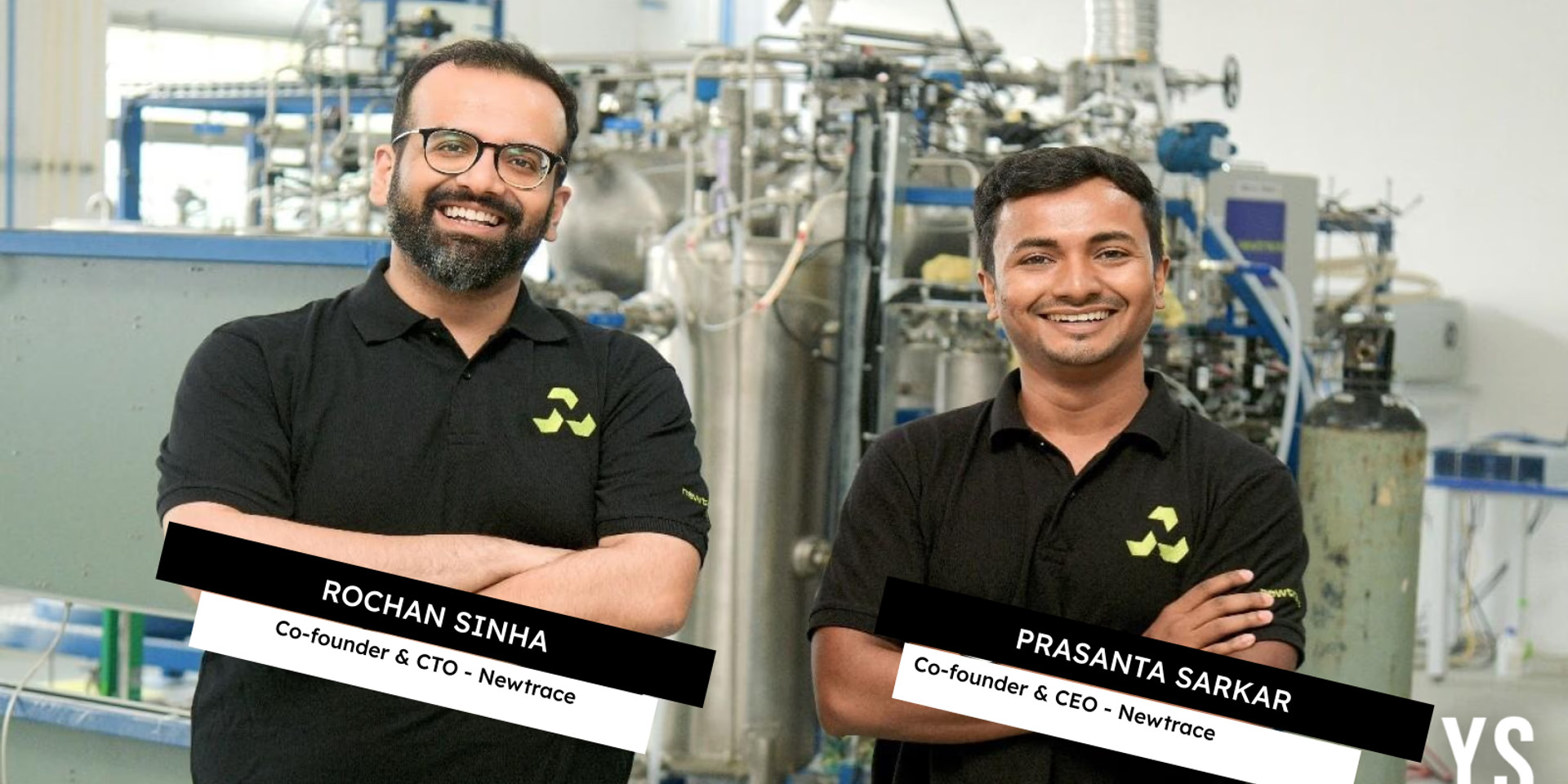
- Prasanta Sarkar (Cofounder & CEO) — Leads the company’s overall strategy and commercialisation agenda. Has been the public face of Newtrace’s mission to make green hydrogen cost-competitive at scale.
- Rochan Sinha (Cofounder) — Focused on the deep engineering and materials science behind the Voltagen electrode technology.
Newtrace was founded in 2021 by these two founders who chose a path that most startup playbooks would advise against — deep, patient, capital-intensive hardware development in a sector where the commercial timeline is measured in years, not months. No viral growth loop. No quick exits. Just the slow, rigorous work of materials science and electrochemical engineering.
Sarkar framed the round’s significance clearly in a post-funding statement:
“Voltagen represents a new materials foundation that enables the efficiency and durability required to make green hydrogen cost competitive. This funding allows us to transition from proving the science to scaling manufacturing.”
That single sentence captures the entire arc of Newtrace’s journey. The science, according to Sarkar, is already proven. What comes next is an entirely different — and arguably harder — kind of challenge.
The Technology — What Voltagen Actually Does and Why It Matters
How Green Hydrogen is Made (Simplified):
- Electricity is passed through water in a process called electrolysis
- Water molecules split — oxygen is released on one side, hydrogen on the other
- If the electricity used comes from renewable sources (solar, wind), the hydrogen produced is called “green hydrogen”
- The machine that performs this process is called an electrolyser
- The electrode is the critical working component inside the electrolyser
Newtrace’s Voltagen Electrode — Key Claims:
- Built on a new materials foundation — a fundamental rethinking, not an incremental upgrade
- Produces ultrapure hydrogen output
- Reduces green hydrogen production costs by up to 60% versus conventional electrolysis
- Patent-pending technology — proprietary and defensible
- Designed for efficiency and durability at commercial operating conditions
This is where Newtrace’s edge lies. The quality of the electrode directly determines how efficiently electrolysis runs, how pure the hydrogen output is, and how long the machine operates before requiring maintenance or replacement. Most current electrolyser designs work well in the lab but degrade rapidly under the sustained stress of commercial-scale operation.
Sixty percent cost reduction is not a rounding error. In a sector where cost-competitiveness is quite literally the difference between mass adoption and irrelevance, a 60% reduction — if it holds at commercial scale — could reshape the entire economics of green hydrogen production in India and potentially beyond.
Use of Funds — The Three-Part Commercialisation Plan
Newtrace has laid out a clear and structured plan for deploying the $6.3 Mn:
Pillar 1 — Pilot-Scale Manufacturing
- Transitioning from laboratory-scale production to repeatable, scalable manufacturing processes
- Based out of the company’s existing 30,000 sq ft facility in Bengaluru
- Stress-testing the Voltagen electrode under real manufacturing conditions rather than controlled lab environments
- Identifying and resolving the inevitable gap between what works at prototype scale and what holds at production scale
Pillar 2 — Customer Validation and Supply Agreements
- Getting Voltagen electrodes into the hands of real industrial customers — hydrogen producers, energy companies, and heavy industry buyers
- Conducting real-world performance validation under actual operating conditions
- Signing supply agreements that create predictable, committed revenue streams as the company scales
- Building customer case studies that demonstrate commercial viability to future investors and partners
Pillar 3 — Expanding Manufacturing and Engineering Capabilities
- Growing the existing team of 45+ engineers and scientists
- Adding manufacturing infrastructure and tooling to support higher production volumes
- Building out engineering capabilities required to customise and optimise Voltagen electrodes for different industrial use cases
The Headline Target: Begin initial commercial deliveries of Voltagen electrodes within the next 12 months.
That’s an ambitious public commitment, and the fact that Newtrace has stated it explicitly suggests a level of manufacturing readiness that goes beyond founder optimism.
India’s Green Hydrogen Policy — The Tailwind Behind the Startup
Newtrace’s fundraise doesn’t exist in a vacuum. It lands squarely in the middle of one of the most ambitious industrial policy pushes India has ever attempted in the clean energy space.
The National Green Hydrogen Mission (NGHM) — Key Facts:
- Launched: January 2023
- Financial Outlay: ₹19,744 Cr
- Production Target: 5 million metric tonnes of green hydrogen per year by 2030
- Strategic Goal: Make India a global hub for green hydrogen production and export
- Four Pillars: Policy framework, demand creation, research and development, enabling infrastructure
- Key Environmental Goal: Phase out grey hydrogen to reduce carbon emissions and fossil fuel dependency
What is Grey Hydrogen and Why Does It Need to Go?
- Grey hydrogen is produced from natural gas through a process called steam methane reforming
- It is currently the dominant form of hydrogen used in India — in fertiliser manufacturing and oil refining
- The production process releases significant quantities of CO₂
- Replacing grey hydrogen with green hydrogen is both a climate imperative and an energy security strategy, reducing India’s dependence on imported natural gas
Additional Policy Support:
- Union Minister Pralhad Joshi announced a dedicated ₹100 Cr R&D scheme in September 2025 specifically to back innovative green hydrogen startups
- This signals government recognition that private-sector startups, not just public sector enterprises, are essential to achieving NGHM targets
For startups like Newtrace, this policy environment creates a rare and powerful alignment — between commercial opportunity, national industrial strategy, and climate necessity.
The Competitive Landscape — Who Else Is Running This Race
Newtrace is not the only company betting on India’s green hydrogen moment. A small but growing ecosystem of startups is building in the same space, each approaching the problem from a different angle.
Key Players in India’s Green Hydrogen Startup Ecosystem:
| Company | Notable Activity | Approach |
| Newtrace | $6.3 Mn Pre-Series A (March 2026) | Voltagen electrode — new materials foundation |
| HYDGEN | $5 Mn equity + debt (October 2025) | Manufacturing automation and electrolyser stack scaling |
| Ohmium | Bengaluru-based PEM electrolyser manufacturer | Proton exchange membrane technology for industrial clients |
| Avaada Group | Green hydrogen capability built on renewable energy base | Leverages existing solar and wind assets as clean electricity feedstock |
Despite this activity, private investor appetite in the green hydrogen sub-segment has remained relatively muted compared to adjacent sectors like EVs or solar energy. Funding rounds have been smaller and fewer. Newtrace’s Pre-Series A, led by a major Indian bank and a Japanese insurance-linked venture fund, is a meaningful signal that this may be beginning to change — and that institutional capital is starting to take green hydrogen seriously as a commercial, not just a policy, opportunity.
Why This Story Is Bigger Than One Funding Round
There is a tendency in Indian startup coverage to treat funding announcements as events — a company raised money, here are the numbers, here are the names. But the Newtrace story is really about something more fundamental: the slow, difficult, unglamorous work of building hard technology that the world actually needs.
What Makes Newtrace’s Journey Significant:
- Founded in 2021 — only four years old, but already at Pre-Series A with a product ready for commercial delivery
- Total funding of approximately $12 Mn across seed and Pre-Series A — relatively lean for deep-tech hardware development
- All major early investors chose to reinvest — a signal that internal metrics have met or exceeded expectations
- Operating from a 30,000 sq ft Bengaluru facility — real manufacturing infrastructure, not just a PowerPoint deck
- A team of 45+ engineers and scientists — significant technical depth for a startup at this stage
- A patent-pending core technology — proprietary moat being actively protected
Green hydrogen is not a consumer app. It doesn’t go viral. There are no daily active user metrics to report. There is just the patient, expensive, rigorous work of materials science, electrochemical engineering, and manufacturing development — work that takes years to pay off, and that most venture investors have historically been reluctant to fund in India.
The fact that Newtrace has attracted credible institutional capital at this stage — and that its existing backers have stayed the course — is a small but meaningful proof point that India’s startup ecosystem is slowly developing the appetite to support deep-tech ventures with long development timelines and genuine industrial impact.
What Happens Next—The Road to Commercial Delivery
Newtrace’s 12-Month Roadmap:
- Pre-Series A funding secured ($6.3 Mn | March 2026)
- Pilot-scale manufacturing ramp at Bengaluru facility
- Customer validation trials with industrial buyers
- Supply agreements finalised with early commercial partners
- Manufacturing and engineering team expansion
- Target: Initial commercial deliveries of Voltagen electrodes within 12 months
Longer-Term Milestones to Watch:
- Series A fundraise (likely 18–24 months from now, post commercial validation)
- Scale-up of manufacturing output beyond pilot volumes
- Potential international market entry — particularly Southeast Asia and the Middle East, both of which have ambitious green hydrogen targets
- Contribution to India’s NGHM target of 5 million metric tonnes annually by 2030
The next 12 months, and those first Voltagen electrode deliveries, will tell us a great deal about whether Newtrace’s science can survive contact with commercial reality. If it can, India may have found one of its most important — and most underappreciated — clean energy bets. If it holds at scale the way it has held in the lab, the 60% cost reduction Newtrace is promising could quietly become one of the most significant developments in India’s energy transition story.
The hard work is only just beginning. And for the 45+ people in that Bengaluru facility, that’s exactly how they like it.