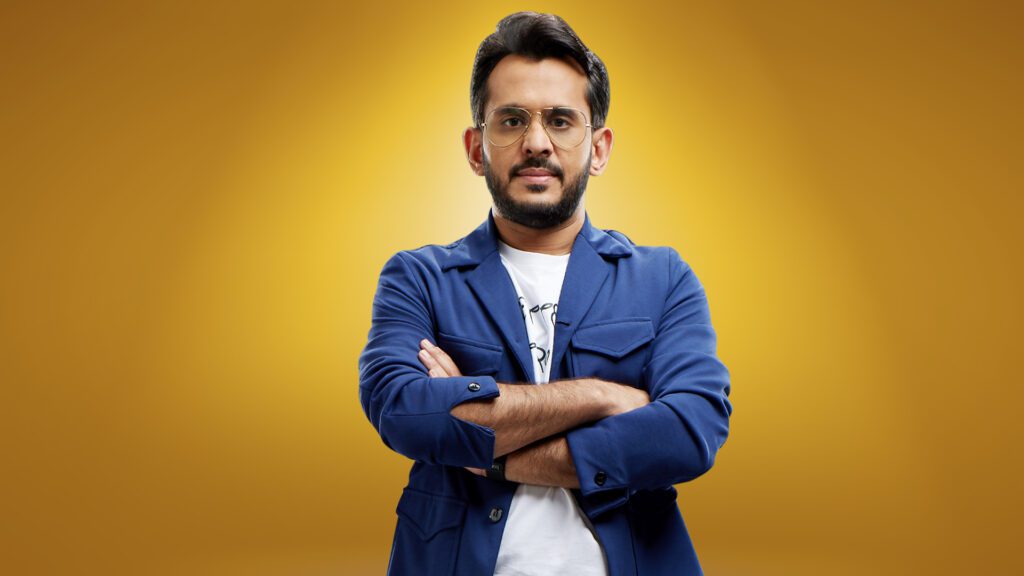
In August 2022, a 28-year-old from Chennai quit his job at OpenAI — just weeks before ChatGPT would change the world — and started a company. Three years later, that company is worth $20 billion, has 100 million monthly users, and makes Google nervous enough to scramble. This is the full Perplexity story.
The Boy from Chennai — Who Is Aravind Srinivas?
Aravind Srinivas was born on June 7, 1994 in Chennai, Tamil Nadu — into a middle-class family. His father was a retired banker. His mother was a homemaker. She used to point at the IIT Madras campus near their home and tell young Aravind: “This is where you are going to study.”
He delivered — spectacularly.
Srinivas graduated as the dual-degree computer science topper from IIT Madras — one of India’s most prestigious engineering institutions. Then he moved to the United States for his PhD in Computer Science at UC Berkeley.
And then came the internships that would shape everything:
| Institution | Role |
| Google Brain | AI Research Internship |
| DeepMind (London) | Research Internship |
| OpenAI | Research Position |
During his DeepMind internship in London, he slept at the office — his rental was terrible. But the office had a library. One night he found a book called “In the Plex” — about Google’s founding. He read it multiple times. The seed of what would become Perplexity was planted right there.
The Big Bet — Leaving OpenAI Before ChatGPT
In August 2022, Srinivas made a move that looked either brave or reckless depending on your perspective — he left his position at OpenAI.
Nobody outside of OpenAI knew what was coming weeks later. Nobody had seen ChatGPT. The AI explosion was not yet public knowledge.
He left anyway.
Together with three co-founders — all AI experts with deep technical backgrounds:
- Denis Yarats (Co-founder & CTO) — formerly Meta AI
- Johnny Ho (Co-founder & Chief Strategy Officer)
- Andy Konwinski (Co-founder) — previously from Databricks/Berkeley
They founded Perplexity AI, Inc. in August 2022 in San Francisco.
Then, seven days after ChatGPT launched, on December 7, 2022, Perplexity went live.
The Big Idea — Answer Engine, Not Search Engine
The fundamental insight behind Perplexity is one that sounds obvious in retrospect but required real conviction in 2022:
Google was broken. Not technically — but experientially.
You type a query. Google gives you ten links. You spend 20 minutes clicking through pages, trying to find an answer. The search engine doesn’t answer — it redirects.
Srinivas and his co-founders built something different. Perplexity is an “answer engine” — you ask a question, and it gives you a direct, concise, cited answer synthesised from real-time web sources.
Unlike ChatGPT in its early form, Perplexity:
- Searches the web in real-time — not just training data
- Cites its sources — every answer is linked to its origin
- Doesn’t hallucinate the way pure LLMs do — because answers are grounded in live search
And crucially — the team decided not to build their own LLM. Srinivas later explained: “It was a decision driven through conviction and pragmatism. Pragmatism because we were broke — and training an LLM could cost tens of millions of dollars. Conviction in that AI models would become increasingly commoditized.”
They started by using GPT-3.5, OpenAI’s LLM available on a pay-per-query basis, and layered their search and answer architecture on top. This model-agnostic approach — using the best available models rather than building their own — became Perplexity’s defining competitive philosophy.
The Funding Rocket — $9M to $20 Billion in 3 Years
Perplexity’s funding trajectory is one of the most dramatic in AI startup history:
| Round | Date | Valuation |
| Seed | 2022 | ~$9M |
| Series A | March 2023 | $121M |
| Series B | January 2024 | $520M |
| Series B Extension | April 2024 | $1B |
| Series C | August 2024 | $3B |
| Series C Extension | January 2025 | $9B |
| Series D | June 2025 | $14B |
| Latest Round | September 2025 | $20B |
| Series E-6 | Early 2026 | $21.21B |
Total funding raised: Over $1.72 billion from 56+ investors.
Who Invested? — A Remarkable Cap Table
- Jeff Bezos (Amazon founder) — personal investment
- Nvidia — strategic investment; signal of technical credibility
- Accel — leading Silicon Valley VC
- SoftBank Vision Fund 2 — $250 million, tripled the valuation to $3B
- IVP — led the $9B valuation round with SoftBank
- Databricks — deep tech validation
- Jeff Dean — Google’s Chief AI Scientist (personal investment)
- Yann LeCun — Meta’s Chief AI Scientist (personal investment)
- Tobias Lütke — Shopify CEO
- Cristiano Ronaldo — took an undisclosed stake in December 2025
The fact that Google’s own Chief AI Scientist personally invested in Perplexity says everything about the threat the company represents.
Business Metrics — How Big Is Perplexity Now?
| Metric | Status (2026) |
| Valuation | $21.21 billion (Jan 2026) |
| Monthly Active Users | 100 million+ |
| Daily Queries | ~30 million |
| Monthly Queries | ~780 million |
| ARR (March 2026) | $450 million+ |
| Revenue Growth | 50% in a single month (Feb-March 2026) |
| Employees | 1,472 (as of March 2026) |
| Internal ARR Target (2026) | $656 million |
In early 2024, Perplexity had approximately $10 million in ARR. By March 2026, it had crossed $450 million — a 45x revenue jump in roughly two years.
Beyond Search — Perplexity’s Pivot to AI Agents
The most significant recent development is Perplexity’s evolution from an answer engine into an AI agent platform.
In early 2026, the company launched Computer — an orchestration layer that taps up to 19 AI models (from OpenAI, Anthropic, Google and others) to execute multi-step workflows autonomously. Rather than answering questions, Computer completes tasks — research, writing, coding, data analysis — assigned by users.
Srinivas described the philosophy: “When you build a team, you don’t build a homogenous group where everyone has the same skills. You build a team with diverse strengths. We’re applying that same logic to AI workflows. The orchestration is the product. The model is a tool.”
This pivot directly takes on Microsoft (Copilot), Salesforce (Agentforce) and other enterprise automation platforms — dramatically expanding Perplexity’s addressable market.
In February 2026, the company also dropped advertising entirely — shifting to a subscription-first model to preserve user trust in AI-generated outputs.
The India Connection — 640% Growth via Airtel
Perplexity has not forgotten its Indian roots. A partnership with Airtel — one of India’s largest telecom providers — brought Perplexity to hundreds of millions of Indian mobile users.
The result: 640% year-over-year user growth in India, proving that Perplexity’s answer engine model resonates deeply with Indian users who demand precision and speed.
Perplexity Pharmacy, Shopping Hub and Comet Browser have all seen strong traction in India, positioning Perplexity as a significant force in India’s AI adoption story.
The Audacious Moves — Chrome Bid & TikTok Proposal
Perplexity has made headlines not just through its product but through bold strategic moves:
January 2025 — TikTok Merger Proposal: On the day before the US ban on TikTok, Perplexity submitted a formal merger proposal to TikTok US.
August 2025 — Chrome Acquisition Bid: Perplexity bid $34.5 billion to buy Google Chrome — arguing that acquiring the browser could remedy antitrust litigation against Google that was potentially compelling Chrome’s sale.
Neither succeeded. But both generated massive global attention and positioned Perplexity as a serious player thinking at the scale of the internet’s biggest platforms.
India’s Youngest Billionaire
In October 2025, Aravind Srinivas debuted on the M3M Hurun India Rich List with an estimated net worth of ₹21,000 crore (approximately $2.5 billion).
At just 31 years old, he became India’s youngest billionaire.
His journey — from a middle-class family in Chennai, to IIT Madras, to UC Berkeley, to OpenAI, to founding a $20 billion company in San Francisco — represents one of the most remarkable individual stories in global technology.
Aravind Srinivas & Perplexity AI — FAQs
Q. Who is Aravind Srinivas?
Co-founder and CEO of Perplexity AI. Born in Chennai in 1994, IIT Madras topper, UC Berkeley PhD, former researcher at Google Brain, DeepMind and OpenAI.
Q. What is Perplexity AI?
An AI-powered “answer engine” that provides direct, cited answers to user questions by searching the web in real-time — unlike traditional search engines that show a list of links.
Q. What is Perplexity AI’s valuation in 2026?
$21.21 billion as of the Series E-6 funding round in early January 2026. The company was valued at $20 billion in September 2025.
Q. How much has Perplexity raised in funding?
Over $1.72 billion from 56+ investors including Jeff Bezos, Nvidia, Accel, SoftBank, Databricks and Google’s Chief AI Scientist Jeff Dean.
Q. What is Perplexity AI’s revenue?
Annual Recurring Revenue (ARR) crossed $450 million in March 2026 — a 50% jump in a single month — on track for a $656 million ARR target by end-2026.
Q. Is Aravind Srinivas a billionaire?
Yes — he debuted on the M3M Hurun India Rich List in October 2025 with an estimated net worth of ₹21,000 crore (~$2.5 billion), becoming India’s youngest billionaire at 31.
Q. Why does Perplexity scare Google?
Perplexity replaces the need to visit multiple websites by giving a direct AI answer — potentially reducing users’ dependence on Google Search. Despite being 0.35% of Google’s volume, it is growing at 800%+ year-over-year.
Q. Is Perplexity available in India?
Yes — via a partnership with Airtel, Perplexity has seen 640% year-over-year user growth in India, making it one of Perplexity’s fastest-growing markets.