
Key Highlights
- Bengaluru-based AGNIT Semiconductors secures $2.6 Mn (approximately ₹24 Cr) in a seed extension round
- The round was led by Shastra VC, with 3one4 Capital and Zephyr Peacock returning as existing investors
- The startup plans to manufacture 1 lakh gallium nitride (GaN) components over the next two years
- AGNIT is now pivoting its focus toward telecom infrastructure and high-efficiency power semiconductor devices
- Currently piloting three distinct semiconductor chips headed toward commercial production
- Prior to this round, the company had raised a cumulative $4.87 Mn since inception
- India’s government is reportedly planning a ₹1 Lakh Cr semiconductor incentive fund
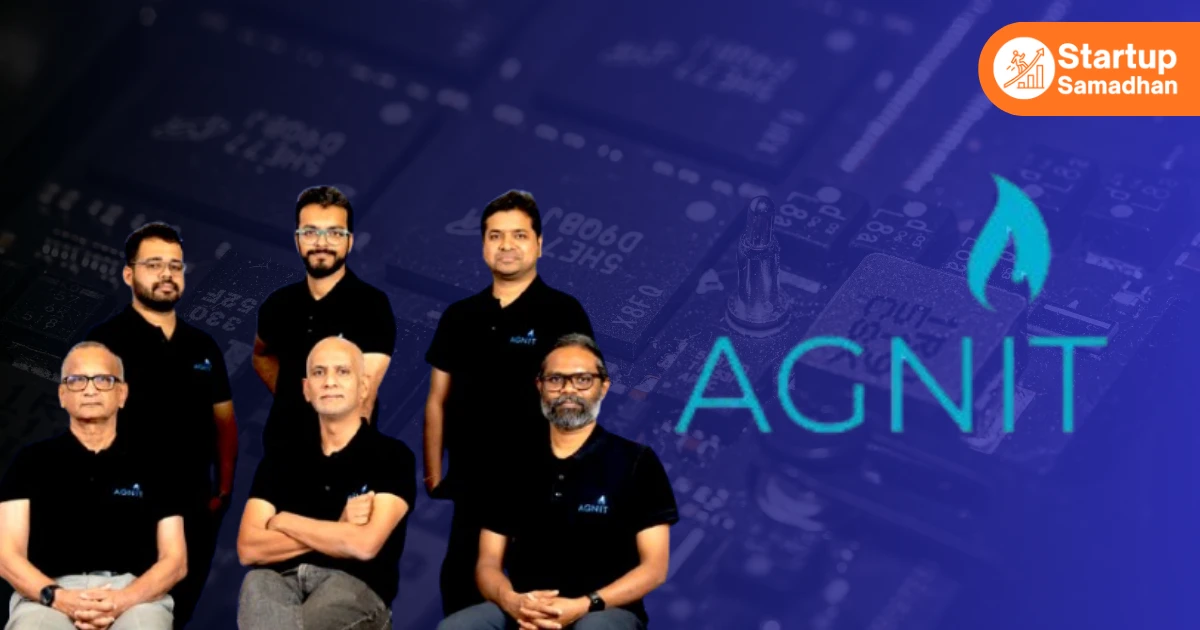
There’s something quietly extraordinary happening in a lab in Bengaluru that most people outside the deep-tech world haven’t paid attention to yet. A seven-year-old startup called AGNIT Semiconductors is slowly, methodically building what could become one of India’s most strategically important chip companies — and this week, it got another financial vote of confidence to keep moving forward.
AGNIT has just closed $2.6 million in a seed extension round, bringing in Shastra VC as the new lead investor, alongside returning backers 3one4 Capital and Zephyr Peacock. The fresh capital — roughly ₹24 crore — isn’t going toward office expansions or flashy hiring sprees. It’s going straight into production lines and product development, with one clear target: build 1 lakh gallium nitride semiconductor components over the next two years while stepping firmly into the telecom infrastructure and power electronics segments.
What Makes GaN So Special?
To understand why investors keep writing cheques to AGNIT, you have to understand what gallium nitride actually is and why the world needs it.
Unlike traditional silicon chips that have powered electronics for decades, GaN-based semiconductors operate at much higher frequencies, handle more power, and generate far less heat. That combination makes them ideal for a range of demanding applications — radio-frequency systems, telecom base stations, power conversion units, and defence electronics, among others. And crucially, GaN technology sits on several export control lists in Western countries, which means India developing homegrown GaN capability isn’t just a business opportunity — it’s a matter of strategic self-reliance.
AGNIT was founded in 2019 by a team of seven professionals with deep domain expertise: Hareesh Chandrasekar, Digbijoy Neelim Nath, Madhusudan Atre, Mayank Shrivastava, Muralidharan Rangarajan, Shankar Kumar Selvaraja, and Srinivasan Raghavan. From day one, the team focused on something most Indian startups haven’t dared to attempt — actually manufacturing GaN wafers and components domestically, not just designing around chips sourced from abroad.
Why Telecom and Power Electronics — And Why Now?
Earlier in its journey, AGNIT had also explored consumer-facing applications, including components for the EV sector. But the team took a sharp, deliberate decision to put that on hold. Hareesh Chandrasekar, cofounder and CEO, was candid about the reasoning: the tailwinds in the strategic sector market were simply stronger, customer interest was more concrete, and the export-restriction status of GaN in defence and telecom segments made the case for homegrown production even more compelling.
That context matters a great deal. When technology is geopolitically restricted, whoever builds it locally holds enormous leverage. India’s telecom operators are aggressively rolling out 5G infrastructure across the country, and power electronics is becoming a critical backbone for everything from data centres to industrial machinery. Sitting at the intersection of both these verticals, with a material that the rest of the world guards carefully, puts AGNIT in a genuinely interesting position.
Right now, the team is piloting three semiconductor chips, and the fresh funding is aimed at scaling up the production volume of all three simultaneously.
The Broader Picture: India’s Semiconductor Moment
AGNIT’s fundraise is not happening in isolation. India’s semiconductor story has been gaining serious momentum, and government intent has started translating into policy muscle. According to a Bloomberg report, the Centre is preparing a fund worth ₹1 lakh crore — over $10 billion — to provide incentives covering chip design projects, manufacturing equipment, and the broader semiconductor supply chain. The government has also set an ambitious benchmark: India’s domestic chip ecosystem should be able to meet 70 to 75 percent of the country’s own semiconductor demand by 2029.
That kind of policy tailwind is making investors move. In just the past two months, semiconductor startups like C2i, Raana Semiconductors, and Sensesemi have all attracted fresh capital from various investors, signalling that the funding environment around deep-tech chips is warming up considerably.
For AGNIT, the timing feels right. The company had previously raised $3.5 million in its initial seed round in 2024, and before this latest extension, its total fundraising stood at around $4.87 million. The new capital takes the company further down the path it has been building toward since 2019 — one chip, one wafer, one strategic step at a time.
India has long consumed semiconductors. AGNIT is quietly beginning to make them. And in a world where the chip supply chain has become one of the defining geopolitical battlegrounds of our era, that matters more than most people realise.