
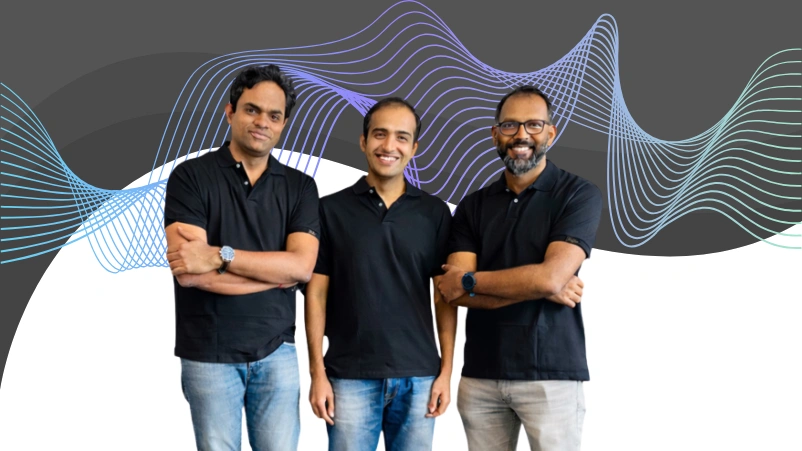
An Indian-origin founding team with CVs that read like a tech dream — OYO’s global COO, a McKinsey partner, and a Jio cloud executive. Their startup just raised $22 million from one of Silicon Valley’s most selective growth investors. Here is the complete Nava story.
The Funding
Nava (formerly known as Kluisz), a cloud infrastructure company building GPU compute and AI data centres across Asia-Pacific, announced a $22 million Series A led by Greenoaks Capital — a San Francisco-headquartered growth equity firm known for backing category-defining technology companies at inflection points.
The round also saw participation from:
- RTP Global — returning backer (also led the seed round)
- Unicorn India Ventures — a leading Indian deep tech investor
Alongside the fundraise, the company announced its rebrand from Kluisz to Nava, reflecting a significant expansion in scope, vision and market positioning.
Funding Journey — From Seed to Series A
| Round | Date | Amount | Lead Investor |
| Seed | July 2025 | $9.6 million | RTP Global |
| Series A | April 9, 2026 | $22 million | Greenoaks Capital |
| Total Raised | — | $31.6 million+ | — |
The Seed round in July 2025 also had participation from Blume Founders Fund and Climber Capital, in addition to Unicorn India Ventures.
The Founders — Who Built Nava?
The founding team is one of the most accomplished in India’s 2025–26 startup cohort:
Abhinav Sinha — Co-founder & CEO Former Global Chief Operating Officer (and CPO) at OYO — one of India’s largest consumer tech scale-ups. Abhinav brings deep experience in scaling operations across markets, managing complex supply chains, and building technology products at enormous scale.
Vamshidhar Reddy — Co-founder Former partner at McKinsey & Company — one of the world’s premier management consulting firms. Vamshi brings strategic clarity and enterprise client relationships to the founding team.
Abhijeet Singh — Co-founder Former cloud executive at Jio — Reliance’s digital and cloud services division. Abhijeet brings deep technical infrastructure knowledge, particularly in building cloud platforms for large-scale enterprise and consumer deployments.
Together, the three founders cover the full arc of what building an AI infrastructure company requires — operational execution at scale (OYO), strategic enterprise thinking (McKinsey), and cloud infrastructure depth (Jio).
What Does Nava Actually Build?
This is the most important question for anyone trying to understand why Greenoaks wrote a $22 million cheque.
Nava is building a full-stack AI cloud infrastructure platform — a “neocloud” — for enterprises across Asia-Pacific. The platform integrates:
| Layer | What It Does |
| AI-Optimised Data Centres | Physical infrastructure purpose-built for AI workloads — not repurposed general-purpose facilities |
| High-Performance GPU Compute | Dedicated GPU-as-a-Service and bare-metal computing for AI model training and inference |
| AI-Native Orchestration | Tools that automatically schedule and run AI workloads in the optimal environment based on constraints like budget, compliance and performance |
| Inferencing Layer | Infrastructure specifically tuned for running AI models at production scale |
| Developer Tools & Access | APIs and tooling that make it easy for enterprise developers to build, deploy and scale AI applications |
In simpler terms — when a company wants to run an AI model (for customer service, analytics, logistics, or any use case), they need massive computing power and reliable infrastructure. Nava builds and manages exactly that, so enterprises don’t have to worry about the underlying complexity.
The company’s platform is designed to let enterprises specify their constraints — budget, compliance requirements, performance needs — and the system automatically handles everything else.
Singapore HQ — Why the Move Matters
As part of its next phase of growth, Nava is establishing Singapore as its regional headquarters, while maintaining core operations in India.
This is a strategic move on multiple fronts:
- Singapore is APAC’s data centre hub — with more developed data centre infrastructure than most other markets in the region
- Regulatory clarity — Singapore offers a stable, enterprise-friendly regulatory environment for cloud and data businesses
- Proximity to key APAC markets — Indonesia, Vietnam, Philippines, Malaysia, Thailand — all undergoing rapid AI adoption
- Global talent access — Singapore attracts senior technology talent from across the world
The India-to-Singapore dual-base model is increasingly common for Indian deep-tech startups targeting APAC enterprise contracts.
Why Greenoaks Led This Round — The Investment Thesis
Greenoaks Capital is known for being highly selective and conviction-driven. It has backed companies like Coupang, Klarna and Notion — category-defining businesses that went on to dominate their spaces.
Its decision to lead Nava’s Series A signals something important: AI infrastructure, not AI applications, is increasingly where sophisticated investors believe the durable value creation will happen.
The reasoning is straightforward. Every company deploying an AI model — for any purpose — needs infrastructure to run it on. The model itself is increasingly commoditised (with open-source models like LLaMA available freely). The infrastructure layer, however, has:
- Broader applicability — every AI user needs it
- More defensible moats — data centres, GPU clusters and enterprise contracts are hard to replicate quickly
- Recurring revenue characteristics — enterprises don’t switch infrastructure providers easily
This shift in investor attention from model-layer to infrastructure-layer AI bets is one of the defining themes of 2026’s global startup funding landscape.
India’s AI Infrastructure Opportunity
India’s position in this story is significant. As one of the largest enterprise markets in Asia — and with a massive base of software and IT companies increasingly integrating AI into their products — the demand for reliable, scalable, affordable AI infrastructure is growing rapidly.
Bhaskar Majumdar, Managing Partner at Unicorn India Ventures, noted the structural shift: “AI is driving rising compute demand, making data centres a critical part of this value chain. As a deep tech investor, we back companies across the AI value chain, and Nava fits well within this strategy.”
India currently has a significant gap between AI application demand and available AI compute infrastructure. Most Indian enterprises rely on hyperscaler clouds (AWS, Azure, GCP) for AI workloads — which is expensive and often suboptimal for the specific requirements of AI model training and inference. Nava is positioning itself as a regional alternative.
What the $22 Million Will Be Used For
The new capital will be deployed across three main areas:
Building GPU Compute Capacity: Expanding GPU clusters and bare-metal computing infrastructure across India and Southeast Asia to serve the growing demand for AI workload computation.
AI Data Centre Development: Building out AI-optimised data centre facilities — particularly in Singapore, where data centre development is more mature, and expanding into other APAC markets.
Talent Acquisition: Hiring senior leadership and high-calibre talent across AI data centre design, GPU engineering, go-to-market functions and operations — across both India and Southeast Asia.
What the Founders and Investors Said
Abhinav Sinha, Co-founder and CEO, Nava: “This fundraise marks an important step in our journey. What started as an AI-native cloud platform has now evolved into something much larger, where we are building the foundational cloud platform layer for AI in Asia. We’re grateful to our investors for their continued support and conviction as we build in a category that is growing and rapidly evolving.”
Madhur Makkar, Principal at RTP Global: “As one of the earliest backers of the company, we have seen Abhinav, Vamshi, and Abhijeet execute with strong clarity and speed in a highly complex space.”
Nava vs The Competition — Market Context
Nava operates in the AI infrastructure and cloud computing space, where it competes with:
| Competitor Type | Examples |
| Global Hyperscalers | AWS, Microsoft Azure, Google Cloud |
| AI-Focused Neoclouds (Global) | CoreWeave, Lambda Labs, Together AI |
| Indian/APAC Regional Clouds | Reliance Jio Cloud, Tata Communications, NTT Data |
| Southeast Asia Specialists | Various emerging regional players |
Nava’s differentiation lies in its vertically integrated, AI-first approach — purpose-built for AI workloads rather than adapted from general-purpose cloud infrastructure — combined with its regional APAC focus and deep understanding of enterprise needs in India and Southeast Asia.
Nava AI Startup Funding 2026 — FAQs
Q. What is Nava and what does it do?
Nava (formerly Kluisz) is an AI cloud infrastructure company that builds GPU compute capacity, AI-optimised data centres and developer tools to help enterprises run AI workloads across Asia-Pacific.
Q. How much has Nava raised in total?
Over $31 million — $9.6 million in a seed round (July 2025) and $22 million in a Series A (April 2026).
Q. Who led Nava’s Series A?
Greenoaks Capital — a San Francisco-based growth equity firm — led the $22 million Series A. RTP Global and Unicorn India Ventures also participated.
Q. Who are Nava’s founders?
Abhinav Sinha (former OYO global COO), Vamshidhar Reddy (ex-McKinsey partner) and Abhijeet Singh (former Jio cloud executive). The company was founded in 2025.
Q. What was Nava called before?
Kluisz — the company rebranded to Nava alongside the Series A announcement.
Q. Where is Nava headquartered?
Nava has established Singapore as its regional headquarters while maintaining core operations in India.
Q. What will the $22 million be used for?
Expanding GPU compute capacity, building AI-optimised data centres, and hiring engineering and operations talent across India and Southeast Asia.
Q. Is Nava an Indian startup?
Yes — it was founded by Indian entrepreneurs (with deep Indian corporate pedigrees at OYO, McKinsey and Jio) and has Indian investors (Unicorn India Ventures, RTP Global via Indian portfolio). It has a dual India-Singapore operating model.