
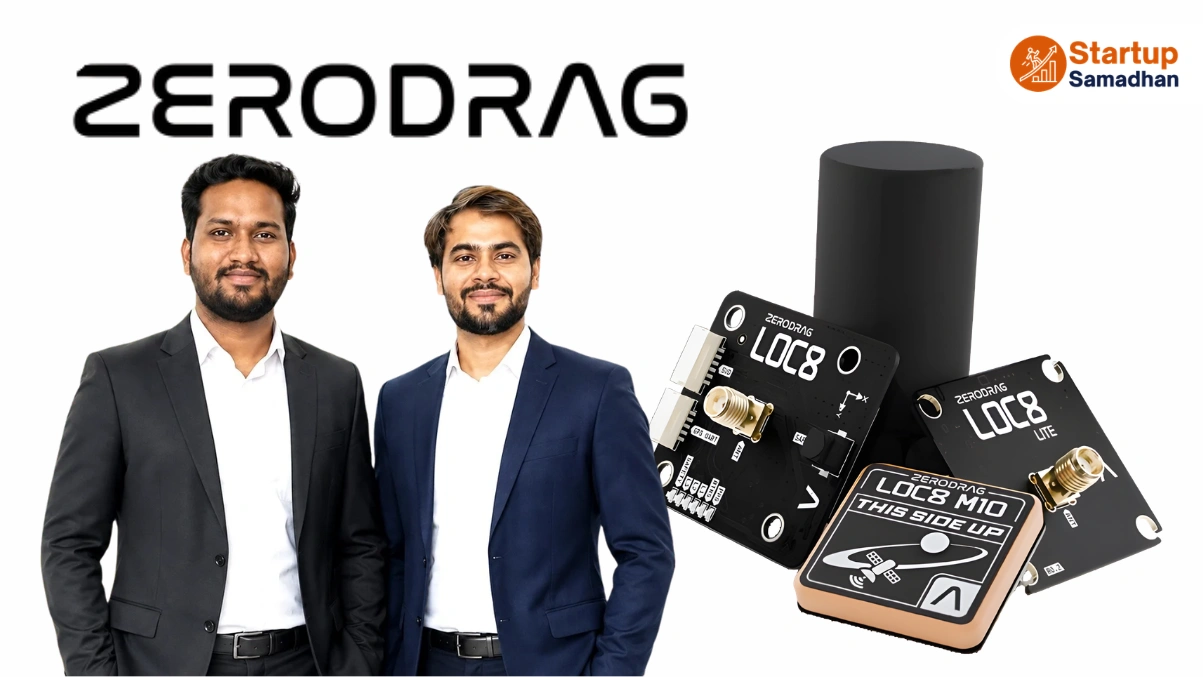
Every drone flying in India today — whether on a defence mission, spraying crops or delivering a package — runs on avionics that are almost entirely made in China. ZeroDrag was founded to change that. And today, Transition VC has put ₹6.5 crore behind that bet. Here is the complete story of India’s most important drone startup you’ve probably never heard of.
The Funding — Key Details
| Detail | Information |
| Company | ZeroDrag Technologies |
| Founded | 2022 |
| Headquarters | Nagpur, Maharashtra |
| Founders | Shantanu Bhede (CEO), Amit Nimje (COO) |
| Amount Raised | ₹6.5 crore (~$680,000) |
| Round Type | Seed Round |
| Lead Investor | Transition VC |
| Previous Funding | ₹1.2 crore pre-seed (September 2023 — Enrission India Capital + angels) |
| Total Funding | ~₹7.7 crore |
| Announced | May 28, 2026 |
What Does ZeroDrag Do? — The Simple Explanation
Founded in 2022 by Amit Nimje and Shantanu Bhede, ZeroDrag develops avionics and sub-components for drones, including autopilots, motor controllers, GNSS modules, telemetry systems and payload integration hardware.
The startup focuses on supplying indigenous electronics to drone manufacturers operating across defence, agriculture, logistics and industrial sectors. Its products are designed to work across different drone platforms and applications.
Think of it this way: a drone is essentially a flying computer. The frame is the body. The motors and propellers are the muscles. But the avionics — the autopilot, navigation systems, communication links, speed controllers — are the brain. Without avionics, a drone is just an inert object.
ZeroDrag makes the brain.
And right now, that brain is almost exclusively made in China for drones sold worldwide — including in India.
The Core Thesis — “Supply Chains Are Weapons”
The most powerful quote from this funding round comes not from the founders but from the investor:
“In an era where supply chains are weapons, India needs SovereignTech. Avionics and flight control are the intelligence layer of every drone, and today that layer is almost entirely Chinese. ZeroDrag is building the foundational technology stack that every Indian drone manufacturer needs, making it not just a product company but a critical piece of national infrastructure.” — Raiyaan Shingati, Co-founder and Managing Partner, Transition VC
And from ZeroDrag’s CEO:
“We’re not building drones. We’re building what every drone needs. If the Indian UAV industry is going to scale, it needs an avionics layer it can actually rely on — and that layer has to come from India.” — Shantanu Bhede, CEO, ZeroDrag Technologies
These two quotes define the entire strategic case for ZeroDrag’s existence: India has a rapidly growing drone industry — 3,000+ registered drone companies, 20,000+ licensed remote pilots, the world’s second-largest drone market by fleet size — but its brains are Chinese. ZeroDrag is India’s answer to that dependency.
The Product Stack — What ZeroDrag Makes
ZeroDrag is a drone avionics and UAV systems company focused on building indigenous electronics, communication systems, and autonomy-ready hardware for drones. The Nagpur-based startup develops autopilots, motor controllers, GNSS modules, telemetry systems, communication infrastructure, and payload integration systems for drone manufacturers, enterprise UAV platforms, FPV users and industrial use cases.
| Product | Function |
| Autopilots | The flight controller — the central brain that processes sensor data and commands motors in real-time |
| Motor Controllers (ESCs) | Electronic Speed Controllers — regulate power to individual motors with millisecond precision |
| GNSS Modules | GPS and satellite navigation systems — determines drone’s position, altitude and velocity |
| Telemetry Systems | Real-time bidirectional data link between drone and ground operator |
| Communication Infrastructure | Radio systems for command, control and video transmission |
| Payload Integration Systems | Hardware interfaces for attaching cameras, sensors, delivery mechanisms |
Every item on this list is currently dominated by Chinese manufacturers — primarily DJI’s Robomaster/Flame Wheel series, Holybro, and dozens of Shenzhen-based component suppliers.
ZeroDrag is building indigenous Indian alternatives for all of them.
Who Are ZeroDrag’s Customers?
ZeroDrag aims to create the foundational electronics layer that enables UAV companies to design, manufacture, and scale reliable drone systems for a wide range of commercial and industrial applications. The company currently supplies high-performance UAV sub-components to drone OEMs operating across defence, agriculture, logistics, and industrial sectors.
ZeroDrag is OEM-agnostic and application-agnostic — it does not build drones itself. It sells avionics to drone manufacturers who then integrate these components into their finished products. This B2B component supply model means:
| Customer Type | Use Case |
| Defence drone OEMs | Surveillance, border patrol, tactical drones for Army/Navy/Air Force |
| Agriculture drone makers | Crop spraying, soil monitoring, precision agriculture drones |
| Logistics drone companies | Last-mile delivery, cargo UAVs |
| Industrial inspection | Pipeline monitoring, power line inspection, infrastructure drones |
| FPV/Racing | First-Person View racing drone builders |
The startup said it was also seeing rising demand from the United States and Europe as manufacturers seek alternatives to Chinese UAV components.
This is the global opportunity: post-pandemic, post-Ukraine, post-US-China tech war, Western drone manufacturers are desperately seeking non-Chinese avionics suppliers. India’s ZeroDrag — an English-speaking, democracy-aligned, technically capable manufacturer — is exactly what they are looking for.
Use of Funds — What ₹6.5 Crore Buys
The proceeds will be used to expand R&D capabilities, scale manufacturing capacity, strengthen testing and quality infrastructure, improve supply chain stability, and accelerate the development of next-generation UAV avionics for Indian and global markets.
Five priority deployments:
| Priority | Detail |
| R&D Expansion | Next-generation autopilot and avionics development |
| Manufacturing Scale | Increased production capacity for growing OEM demand |
| Testing & Quality | Lab infrastructure for flight testing, EMI/EMC certification |
| Supply Chain | Domestic component sourcing to reduce import dependency |
| Global Market Entry | Sales and partnerships in US and European markets |
12–24 Month Roadmap — What Comes Next
Over the next 12 to 24 months, ZeroDrag plans to scale its manufacturing capabilities, expand its engineering team, improve product availability, and broaden its product portfolio into enterprise-grade UAV hardware solutions. This will also include systems designed for heavy-lift drones and future eVTOL platforms.
Two significant expansions flagged:
Heavy-lift drones: Moving beyond small consumer/commercial drones into heavy-lift UAVs — used for cargo delivery, construction material transport and military logistics — which require more powerful and sophisticated avionics.
eVTOL (Electric Vertical Take-Off and Landing): The next frontier of urban air mobility — air taxis and cargo copters. Building avionics for eVTOL platforms now positions ZeroDrag at the bleeding edge of what India’s aviation regulator is beginning to open up for testing.
Who Is Transition VC?
Transition VC is an early-stage Indian venture capital fund focused on deeptech, defence-adjacent and climate technology startups. Led by Raiyaan Shingati as co-founder and managing partner, the fund backs companies building foundational technology infrastructure — exactly ZeroDrag’s positioning.
Transition VC’s conviction in ZeroDrag reflects a broader thesis among Indian deeptech investors: the post-PLI drone boom has created strong demand for indigenous components, but most of the money has gone to drone frame manufacturers rather than the electronics layer. Whoever builds the avionics layer becomes critical infrastructure for the entire Indian drone industry.
The Market — India’s Drone Sector in 2026
| Metric | Figure |
| Registered Drone Companies in India | 3,000+ |
| Licensed Remote Pilots (DGCA) | 20,000+ |
| India Drone PLI Scheme Outlay | ₹120 crore |
| India Drone Market (2026 projected) | $1.8 billion |
| India Drone Sector Funding (2026 YTD) | $12.3 million |
| Global Drone Market (2030 projected) | $55+ billion |
India’s PLI scheme for drones has catalysed the manufacturing of drone frames domestically — but avionics (the electronics) have largely continued to come from China. Every drone frame manufacturer that gets PLI benefits is a potential ZeroDrag customer if they want to go fully indigenous.