Every AI company has a billing problem. The moment you move from flat subscription pricing to charging per API call, per token or per GPU hour, your legacy billing tool falls apart. New Delhi’s Flexprice was built specifically to fix that — and today it has a $1.5 million seed round to prove the market agrees.
The Funding — Key Details at a Glance
| Detail | Information |
| Company | Flexprice |
| Founded | 2024 |
| Headquarters | New Delhi (teams in Bengaluru & San Francisco) |
| Founders | Manish Choudhary (CEO), Nikhil Mishra (CTO) |
| Amount Raised | $1.5 million |
| Round Type | Seed Round |
| Lead Investor | Shastra VC (formerly Veda VC) |
| Participating Investors | TDV Partners, Anupam Mittal (People Group founder) |
| Previous Round | $500K pre-seed from TDV Partners (July 2025) |
| Total Funding | ~$2 million |
| Announced | May 26, 2026 |
What Is Flexprice? — The Problem It Solves
Founded in 2024, Flexprice develops open-source billing infrastructure that helps AI companies manage pricing across API calls, token usage, GPU hours, and hybrid billing models.
The problem is real and growing. Over two thirds of SaaS companies are now launching or integrating GenAI features, dramatically increasing infrastructure costs and altering customer value perception. To adapt, a majority of SaaS and API-first businesses are shifting away from static subscriptions in favour of usage-based or hybrid billing models that better align pricing with actual customer usage.
But the tools haven’t kept up. Legacy billing tools, built for a predictable, seat-based SaaS world, struggle to meet the demands of today’s dynamic, metered AI and API-first business models. As a result, engineering teams end up spending months building and maintaining complex infrastructure for metering, entitlement gating, usage aggregation, and billing.
Flexprice eliminates that months-long engineering detour.
What Does the Platform Do? — Inside Flexprice
Flexprice is purpose-built for usage-based billing from day one, not retrofitted onto a subscription engine. Every pricing model is supported natively — usage-based, credit-based, outcome-based, seat-based, hybrid, enterprise contracts, and volume tiers.
Key platform capabilities:
| Feature | Details |
| API Call Billing | Track and charge per individual API call in real-time |
| Token Usage Metering | Per-token billing for LLM/AI model consumption |
| GPU Hour Tracking | Cloud compute billing for AI workloads |
| Hybrid Pricing Models | Mix subscription + usage + credits in one billing system |
| Entitlement Gating | Control feature access based on plan and usage |
| AI Cost Sheet | Cost-of-delivery visibility per customer — something no other open-source billing tool offers |
| Revenue Recognition | New product being built with this round |
| Financial Reporting | Automated revenue and usage reporting for finance teams |
| Open-Source Core | Self-hostable on AWS, GCP, Azure or bare metal — SOC 2 compliant |
Payment gateway integrations include Stripe, Adyen and Razorpay.
Traction — The Numbers That Won the Round
According to the company, its revenue grew 6X in the last quarter, while event processing volume surged 20X over the past year to more than 20 billion events per month.
| Metric | Figure |
| Revenue Growth (last quarter) | 6X |
| Event Volume Growth (last year) | 20X |
| Events Processed Monthly | 20 billion+ |
| Platform Status | Production-proven |
| Founded | 2024 |
| Previous Funding | $500K pre-seed (July 2025) |
20 billion events per month processed by a company that is barely 18 months old — this is the metric that tells the real story of how fast AI billing complexity is growing, and how quickly Flexprice has become critical infrastructure for its customers.
The Founders — Who Built Flexprice?
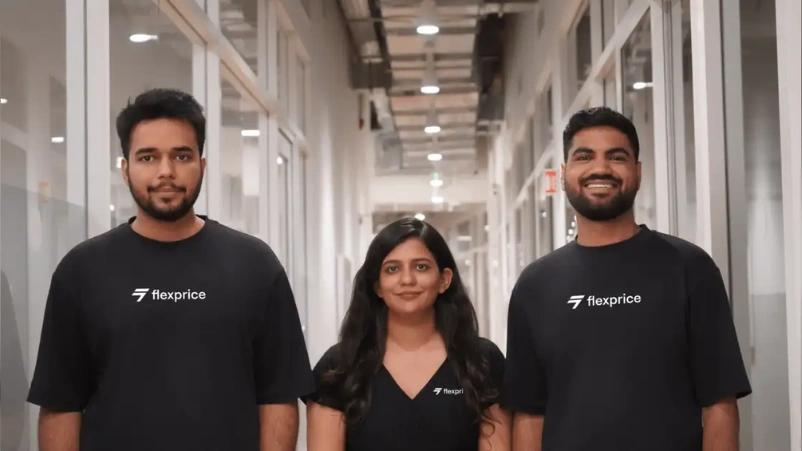
Manish Choudhary (CEO) built Flexprice around a clear conviction: “AI and agentic teams need to move fast. Pricing, packaging and billing should never be a bottleneck. We built Flexprice to give developers control, flexibility and scalability.”
Nikhil Mishra (CTO) brings the open-source philosophy that defines Flexprice’s architecture: “We believe open infrastructure is the future. Our goal is to make modern billing accessible, composable, and cost-effective — whether you’re an early-stage startup or a scaling enterprise.”
The decision to go open-source is deliberate and strategic. It builds developer trust, allows enterprises to self-host for compliance, and creates a community-driven product roadmap — all of which are critical for infrastructure tools selling to engineering teams.
Who Invested — The Investor Profiles
Shastra VC (Lead Investor)
Shastra VC, formerly Veda VC, recently launched a $100 million fund focused on early-stage startups in deeptech, artificial intelligence, climate tech, spacetech, defence, and renewable sciences.
Flexprice’s AI billing infrastructure positioning — at the intersection of AI and enterprise software — sits squarely within Shastra VC’s deeptech and AI mandate. Leading the seed round signals Shastra’s conviction that billing infrastructure for AI companies is a category-defining opportunity.
Anupam Mittal — Personal Investment
Anupam Mittal is the founder of People Group — the parent company of Shaadi.com, India’s most recognised matrimony platform — and one of India’s most recognisable startup investors, best known to the mass audience as a judge on Shark Tank India.
Mittal’s personal participation in the Flexprice seed round brings both capital and a level of mainstream startup credibility that helps Flexprice’s brand — especially in India where Shark Tank India has made him synonymous with backing high-conviction early-stage bets.
TDV Partners (Continuing Investor)
TDV Partners led Flexprice’s $500K pre-seed round in July 2025 and participated again in this seed round — a strong signal of the firm’s continued confidence in the team and thesis as both have evolved over the past 10 months.
Use of Funds — Building Beyond Billing
The fresh capital will be used to expand into the US and Europe while building products beyond billing, including metering, revenue recognition, and financial reporting tools.
The “beyond billing” expansion is significant. Flexprice is positioning itself not just as a billing tool but as a full-stack revenue operations platform for AI companies — covering the entire journey from usage tracking to revenue recognition to financial reporting.
For a CFO or finance team at an AI startup, this is deeply attractive: one platform that handles the entire consumption-to-cash workflow.
Three-pronged expansion:
| Priority | Detail |
| US Expansion | Enterprise sales team, customer support and local partnerships |
| Europe Expansion | GDPR-compliant infrastructure, EU payment gateway integrations |
| Product Expansion | Metering → Revenue Recognition → Financial Reporting |
The Delhi Startup Angle
Flexprice is headquartered in New Delhi — with engineering teams in Bengaluru and San Francisco. The company is headquartered in New Delhi and has teams in Bengaluru and San Francisco.
This makes Flexprice one of the relatively rare deep-tech infrastructure startups to be based out of Delhi — a city whose startup ecosystem is more commonly associated with B2C consumer platforms, edtech and fintech than with developer-tools or AI infrastructure. Flexprice’s emergence reinforces a growing trend of deep-tech founders choosing Delhi NCR as a base for global products.
Competition — The Billing Infrastructure Landscape
Flexprice operates in a growing but highly competitive space:
| Competitor | Type | Gap vs Flexprice |
| Stripe Billing | Payment + Billing | Subscription-first, not usage-native |
| Chargebee | Subscription Management | Built for SaaS subscriptions, not AI metering |
| Metronome | Usage-Based Billing (US) | Closed-source, expensive, US-focused |
| Orb | Usage-Based Billing (US) | Closed-source, enterprise pricing |
| Lago | Open-Source Billing | Direct competitor — also open-source |
Flexprice’s differentiators: open-source + self-hostable + AI-native from day one + Indian pricing for Indian startups + integrated AI Cost Sheet.