India is eating differently. And investors are taking serious notice of who’s feeding that shift.
Anveshan — the D2C brand that brought A2 bilona ghee and cold-pressed mustard oil to a generation of urban Indians rethinking what goes into their food — has just raised ₹150 crore in Series B funding. And the names on the cap table are as impressive as the product lineup.
The Funding: ₹150 Crore Series B — Led by Vertex Ventures
D2C food brand Anveshan has raised ₹150 crore (around $15.8 million) in its Series B funding round led by Vertex Ventures Southeast Asia & India.
This is a major step up from where Anveshan was just a year ago.
With this raise, Anveshan’s valuation has nearly doubled to approximately ₹846 crore from around ₹430 crore during its previous Series A funding round — the sharp increase reflecting rising investor confidence in the company’s growth trajectory.
The Investor Lineup — A Star-Studded Cap Table
The round also saw participation from World Bank Group’s International Finance Corporation, Swiggy co-founder Sriharsha Majety, and existing investors including Wipro Consumer Care Ventures, Titan Capital Winners Fund, Force Ventures, and boAt founders Aman Gupta and Sameer Mehta.
Let’s unpack that for a moment. In a single funding round, Anveshan has:
- Vertex Ventures — One of Southeast Asia’s most respected growth investors
- IFC (World Bank Group) — Global development finance institution backing sustainable businesses
- Sriharsha Majety — The man who built Swiggy into India’s food delivery giant
- Aman Gupta & Sameer Mehta — The founders of boAt, India’s most successful consumer electronics brand
- Wipro Consumer Care Ventures — FMCG strategic investor
- Titan Capital — Seed-to-growth backer of India’s best D2C brands
When investors from food delivery, consumer electronics, FMCG, and global development finance all back the same company — that’s not a coincidence. That’s a consensus signal about a very real market shift.
According to regulatory filings, Vertex Ventures invested ₹75 crore in the round, while IFC contributed ₹31 crore.
Who Founded Anveshan — and Why?
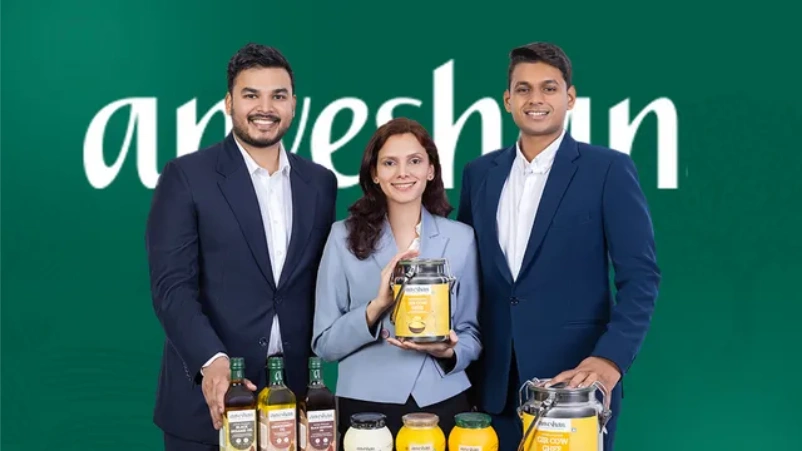
Founded in 2020 by Kuldeep Parewa, Akhil Kansal, and Aayushi Khandelwal, Anveshan is a clean and premium food brand that offers products like ghee, cold-pressed oils, raw honey, and Indian superfoods.
The founding thesis was deceptively simple: India’s traditional food-making methods produce better, healthier food than factory-made alternatives — but most consumers can’t access them because the supply chain has been industrialised for decades.
Anveshan has built a differentiated D2C business model by focusing on minimally processed food products sourced and produced through rural micro-entrepreneurs. The company combines traditional food-making methods with modern quality standards, creating economic opportunities for farmers and village-based producers while delivering authentic products directly to consumers.
This is not just a clean food company. It’s a supply chain transformation project disguised as a consumer brand.
What Does Anveshan Actually Sell?
Anveshan sells minimally processed food products including A2 bilona ghee, cold-pressed oils, raw honey, atta and other nutrition-focused products. It operates through a network of rural producers and micro-entrepreneurs across India.
Here’s what makes each product category meaningful:
A2 Bilona Ghee — Made using the traditional bilona (hand-churning) method from A2 milk of indigenous cow breeds. No shortcuts, no adulteration. This is the product that put Anveshan on the map.
Cold-Pressed Oils — Extracted without heat, preserving natural nutrients, flavour and fatty acid profiles that high-temperature extraction destroys.
Raw Honey — Unprocessed, unheated, sourced directly from beekeepers — retaining enzymes, antioxidants and pollen that pasteurised commercial honey loses.
Atta — Whole wheat flour stone-ground the traditional way, without the bleaching and refining that strips fibre and nutrients from commercial flour.
Every product in Anveshan’s range answers the same question: what did Indians eat before the food industry optimised for shelf life instead of nutrition?
The Revenue Story — From Zero to ₹300 Crore ARR in 5 Years
Anveshan claims to be operating at an annual revenue run rate of ₹280–300 crore and is targeting ₹1,000 crore in revenue over the next 24–30 months.
For the fiscal year ended March 2025, Anveshan reported a 64.6% increase in operating revenue to ₹77.08 crore from ₹46.84 crore in FY24. Its losses widened to ₹11.88 crore in FY25 from ₹5.74 crore in the previous fiscal year.
The revenue-to-ARR gap is massive — from ₹77 crore in FY25 revenue to ₹280–300 crore ARR today. That tells you just how fast the company has been growing in the last 12 months, riding quick commerce platforms like Blinkit, Zepto, and Swiggy Instamart that have made premium food delivery accessible to urban consumers across India.
The losses are widening — but that’s investment in growth, not structural inefficiency. With ₹150 crore in fresh capital, the company now has the runway to scale profitably.
Why Quick Commerce Changed Everything for Anveshan
Sources say the company has been riding the quick-commerce channel to expand fast and drive repeat purchases.
Here’s the insight that most people miss. Clean food brands like Anveshan used to struggle with distribution — their products needed refrigeration, careful handling, and consumer education at the point of sale. Traditional kirana stores couldn’t provide any of that.
Quick commerce flipped the model. Blinkit, Zepto and Swiggy Instamart’s 10-minute delivery model suddenly made it possible for premium clean food brands to be discovered, tried, and repeatedly purchased by urban households — without the friction of planning a supermarket trip.
Anveshan was perfectly positioned to capture this shift. Its products are exactly what the health-conscious, upper-middle-class urban consumer is looking for — and quick commerce brought that consumer directly to Anveshan’s digital shelf.
What Will ₹150 Crore Be Used For?
Anveshan plans to utilise the capital to strengthen its manufacturing capabilities, accelerate product innovation, and expand its omnichannel presence. The D2C startup will also invest in improving its infrastructure, procurement systems, and advanced testing capabilities. A part of the freshly raised funds will be used to deepen partnerships with procurement sources like micro-entrepreneurs and traditional food producers.
In plain terms — five clear deployment areas:
- Manufacturing scale — bigger capacity to meet surging demand
- New products — expanding beyond ghee and oils into adjacent clean food categories
- Offline expansion — taking the brand beyond digital into physical retail
- Quality infrastructure — testing, sourcing systems, traceability
- Rural producer network — more micro-entrepreneurs, more authentic sourcing
The Total Funding Journey — From ₹3.67 Crore to ₹150 Crore
Anveshan’s funding milestones include its seed round in September 2021 at ₹3.67 crore led by DSG Consumer Partners and Titan Capital, a Pre-Series A of $2 million in September 2022, Series A of ₹48 crore in April 2025, and now this Series B of ₹150 crore in June 2026.
| Round | Date | Amount |
| Seed | September 2021 | ₹3.67 Crore |
| Pre-Series A | September 2022 | ~₹17 Crore |
| Series A | April 2025 | ₹48 Crore |
| Series B | June 2026 | ₹150 Crore |
| Total Raised | ~₹220 Crore |
That funding trajectory — from under ₹4 crore to ₹150 crore rounds in five years — reflects exactly what India’s clean food market has done in the same period.
The Bigger Picture — India’s Clean Food Revolution Is Real
Investor interest is building across organic and clean-label food brands. Organic dairy startup Akshayakalpa Organic is raising ₹175 crore, led by Singapore-based investor ABC Impact.
India’s clean food segment is no longer a niche lifestyle category for Mumbai and Bengaluru elites. It is going mainstream — driven by rising health consciousness post-COVID, growing distrust of ultra-processed food, and the availability of premium clean food through quick commerce in Tier-2 cities.
Anveshan is riding the crest of this wave — with the right product range, the right distribution channel strategy, and now the right capital and investor network to scale to ₹1,000 crore.
Anveshan
| Detail | Info |
| Startup | Anveshan |
| Founded | 2020 |
| Founders | Kuldeep Parewa, Akhil Kansal, Aayushi Khandelwal |
| Round | Series B |
| Amount Raised | ₹150 Crore (~$15.8 Mn) |
| Lead Investor | Vertex Ventures Southeast Asia & India |
| Other Investors | IFC (World Bank), Sriharsha Majety, Aman Gupta, Sameer Mehta, Wipro, Titan Capital |
| Valuation | ~₹846 Crore |
| Current ARR | ₹280–300 Crore |
| Revenue Target | ₹1,000 Crore (24–30 months) |
| FY25 Revenue | ₹77.08 Crore (up 64.6% YoY) |
| Total Funding | ~₹220 Crore |
| Key Products | A2 Bilona Ghee, Cold-Pressed Oils, Raw Honey, Atta |
| Distribution | D2C, Quick Commerce, Offline (expanding) |
Bottom Line — The Clean Food Wave Has Found Its Leader
India has dozens of clean label food startups. Very few have cracked distribution, built consumer trust at scale, and attracted a cap table this strong.
The company plans to expand its atta portfolio, strengthen its owned digital channels, scale offline distribution, and continue investing in product innovation — targeting ₹1,000 crore in revenue over the next 24–30 months.
With Vertex Ventures, the World Bank’s IFC, and India’s most credible founder-investors all aligned behind Anveshan — the question is no longer whether clean food will go mainstream in India. The question is whether Anveshan will be the brand that defines the category.
Right now, all signs point to yes.